

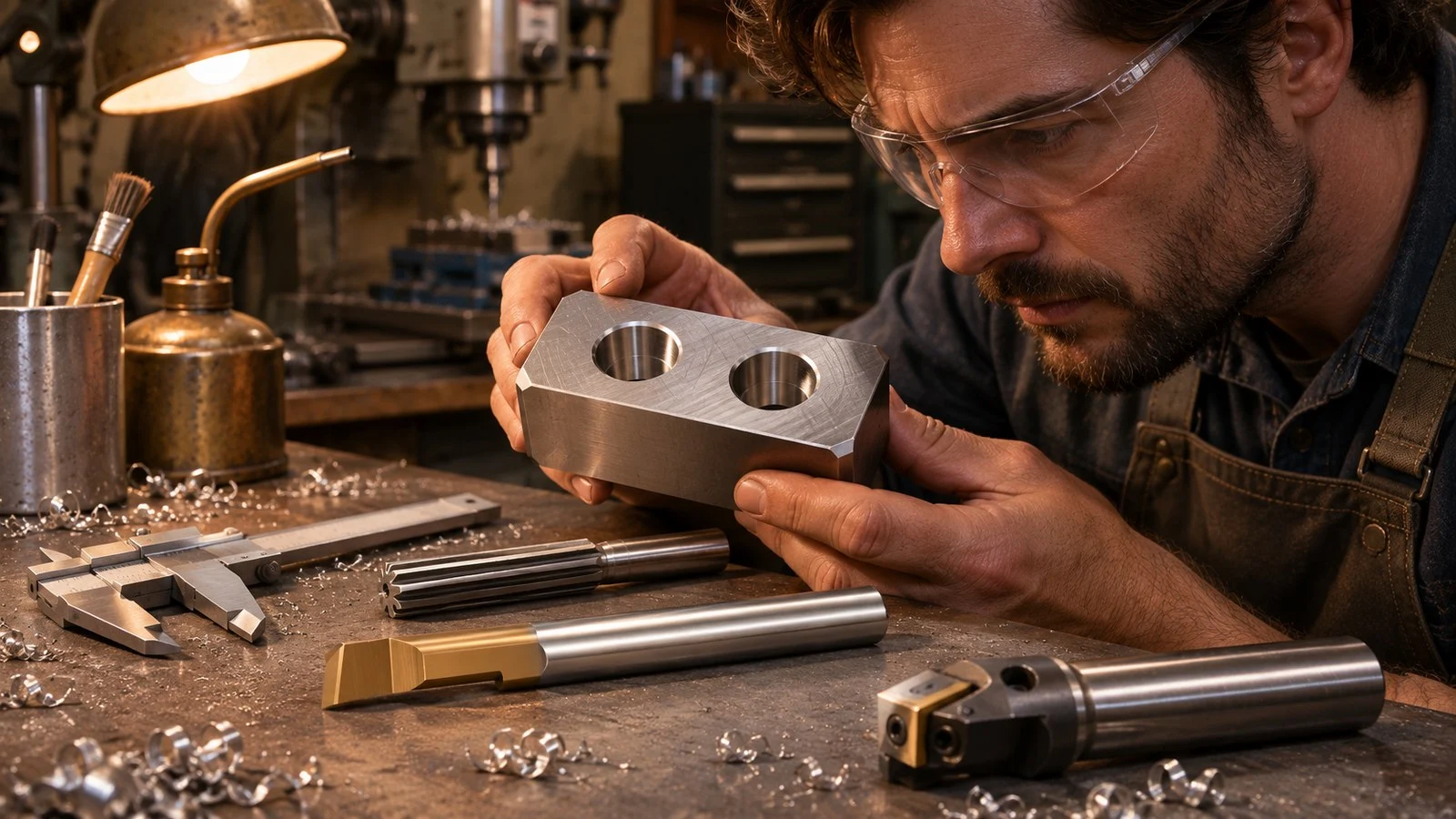
Reaming is a good choice when an existing hole is already well positioned and you need to bring it to its required size and finish. Boring is the better choice when the existing hole’s path needs more correction or when you’re finishing a variety of hole sizes in short runs.
Reaming vs Boring: Key Differences
Reaming and boring both enlarge an existing hole, but they use different tools and offer different levels of control over the hole’s path. A reamer tends to follow the existing hole, while a boring bar is less influenced by that path. Neither operation guarantees a particular result without a suitable setup.
| Consideration | Reaming | Boring |
|---|---|---|
| Cutting tool | Reamer | Boring tool, such as a single-point tool |
| Main purpose | Bring an existing hole to the required size and finish | Enlarge an existing hole while controlling the cutting path |
| Existing hole alignment | Tends to follow the existing path | Less influenced by the existing path |
| Job suitability | Useful when the existing hole is already well positioned | Useful for varied, low-volume jobs or holes needing path correction |
| Speed | Depends on the tool and setup | Depends on the tool and setup |
Reaming: Strengths, Drawbacks and Uses
Reaming enlarges an existing round hole with a reamer to reach the required size and smooth the hole surface. It suits a finishing operation where the preceding process has already produced a hole with acceptable location and alignment.
The drawback is that a reamer tends to follow the hole it enters. Don’t rely on reaming to correct location or alignment errors beyond very small discrepancies. When planning the machining sequence, check the incoming hole before choosing reaming as the finishing step.
Boring: Strengths, Drawbacks and Uses
Boring enlarges an existing hole by removing material with a boring tool. In single-point boring, a rigidly mounted cutting edge removes material from the hole wall. Because the tool is less influenced by the existing path, boring is useful when that path needs correction.
Boring can also suit prototypes, short runs and jobs with varying hole requirements. Its drawback is that the result still depends on the setup: choosing boring alone doesn’t guarantee straightness, location or concentricity. For a listed boring product, our MTR type boring page provides a starting point for identifying the tool.
Boring Before Reaming
You can use both operations on the same hole. A boring pass can address the existing hole’s path before reaming brings the hole to its required size and finish. This sequence is useful when the initial hole isn’t suitable for reaming alone.
Which Operation Should You Choose?
Choose reaming if:
- The existing hole’s location and alignment are acceptable.
- You need to bring the hole to its required size and finish.
Choose boring if:
- The existing hole’s path needs correction before finishing.
- You’re handling varied hole requirements in a short run.
For either choice, inspect more than the surface finish. Check the dimensions and geometric requirements on the drawing, including diameter, roundness, straightness and concentricity where applicable. When comparing reaming vs boring, use those requirements to decide whether one operation is sufficient or a boring pass should precede reaming.
FAQ
What Is Reaming in Drilling?
Reaming is a separate operation performed after a hole has been made. It enlarges the existing hole to reach the required size and finish.
How Do Drilling and Boring Differ?
Drilling creates a round hole in a workpiece. Boring enlarges a hole that already exists.
What Is the Definition of Reaming?
Reaming is the process of enlarging an existing round hole with a reamer to produce the required size and a smooth surface.
Can Boring Be Faster Than Reaming?
Yes, a particular boring setup can be faster than a particular reaming setup. Compare the tools and conditions for your job rather than assuming either operation is always faster.