

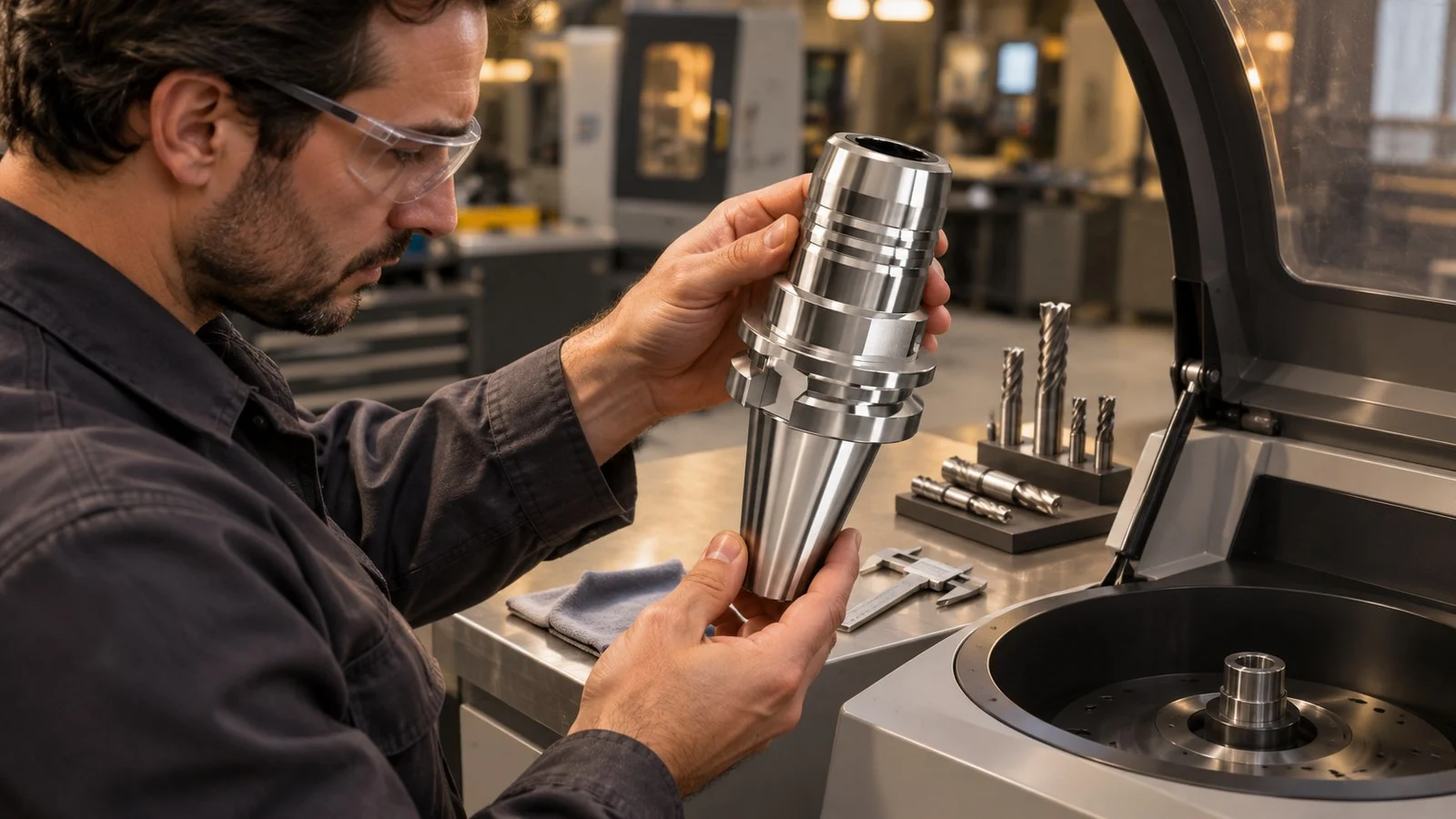
Tool holder balancing checks how mass is distributed around the axis of a rotating tool assembly. Check the complete assembly against the requirements for its intended operating speed: a holder balanced on its own may need another check once the cutting tool and other components are installed.
Why Balance the Complete Tool Assembly?
Tool holder balancing concerns the holder and the components that rotate with it. A cutting tool, collet, nut, clamp or other fitted part can change the assembly’s mass distribution. A prebalanced holder is therefore a useful starting point, but its marking alone doesn’t confirm that the assembled tool meets a balance target.
For example, a cutting tool with an asymmetric shank or profile can change the balance of an otherwise balanced holder. Collets, clamping nuts and stop screws also contribute. The result depends on the parts fitted and their position in the assembly.
A balance marking needs context. Keep the maker’s stated grade, speed and setup together when assessing a holder for use. When selecting a holder from our machining range, use the applicable machine and toolmaker instructions to determine what the completed assembly must meet.
How Speed Changes the Balance Check
A balance-quality designation such as G2.5 describes a balance grade; it isn’t an RPM rating. A statement such as “G2.5 at 25,000 rpm” includes both a grade and the speed associated with that balance condition. It still needs to be read alongside the specified assembly and setup.
Before accepting a marking, check:
- The stated speed: Is it relevant to the intended operating speed?
- The assembly covered: Does the marking apply to the holder alone or to the fitted tool assembly?
- The acceptance requirement: What do the machine and tool makers specify for the intended setup?
Don’t treat a grade on its own as permission to run at any particular speed. Follow the applicable speed limits and balance requirements for the equipment and components in use.
Balance, Runout and Vibration
Mass imbalance describes an uneven distribution of rotating mass around the axis. It can contribute to vibration. Unbalance is expressed as mass multiplied by its distance from the axis, for example in gram-millimeters, written as gmm.
Geometric runout is a different condition: it concerns how a surface or cutting edge moves relative to the axis of rotation. A balance check doesn’t measure runout, and a runout check doesn’t establish the assembly’s balance. Vibration or chatter can also have causes unrelated to mass imbalance, so vibration alone isn’t a diagnosis.
One-Plane and Two-Plane Balancing
One-plane balancing addresses unbalance in one correction plane. Two-plane balancing uses two correction planes and accounts for how unbalance is distributed along the assembly.
The choice depends on the assembly’s geometry, operating speed, equipment and applicable instructions. Two-plane balancing provides information across two planes but requires equipment and a procedure suited to that task. Neither method should be selected from speed alone, and balancing corrections require appropriate equipment.
When to Recheck an Assembly
Reassess the balance requirement when a change can alter the rotating assembly. Rechecking may be appropriate after replacing a cutting tool, collet, nut or clamp, or after indexing inserts in an indexable cutter. The machine and toolmaker instructions determine whether a check or correction is required for the particular setup.
With the equipment stopped and safe for manual inspection, identify the components fitted and compare the assembly with the configuration covered by its balance record. If the configuration or intended speed has changed, use the specified checking procedure and acceptance criteria before returning the assembly to service.
FAQ
Does a Prebalanced Holder Need Rechecking?
It may. Fitting a cutting tool and other rotating components can change the balance, so check the complete assembly when required by the applicable machine and toolmaker instructions.
Is G2.5 a Speed Rating?
No. G2.5 is a balance-quality designation. Read it with the stated speed and the assembly configuration to which it applies.
Does Balancing Correct Tool Runout?
No. Balancing addresses mass distribution; runout concerns the movement of a surface or cutting edge relative to the rotation axis. Each condition needs its own check.