

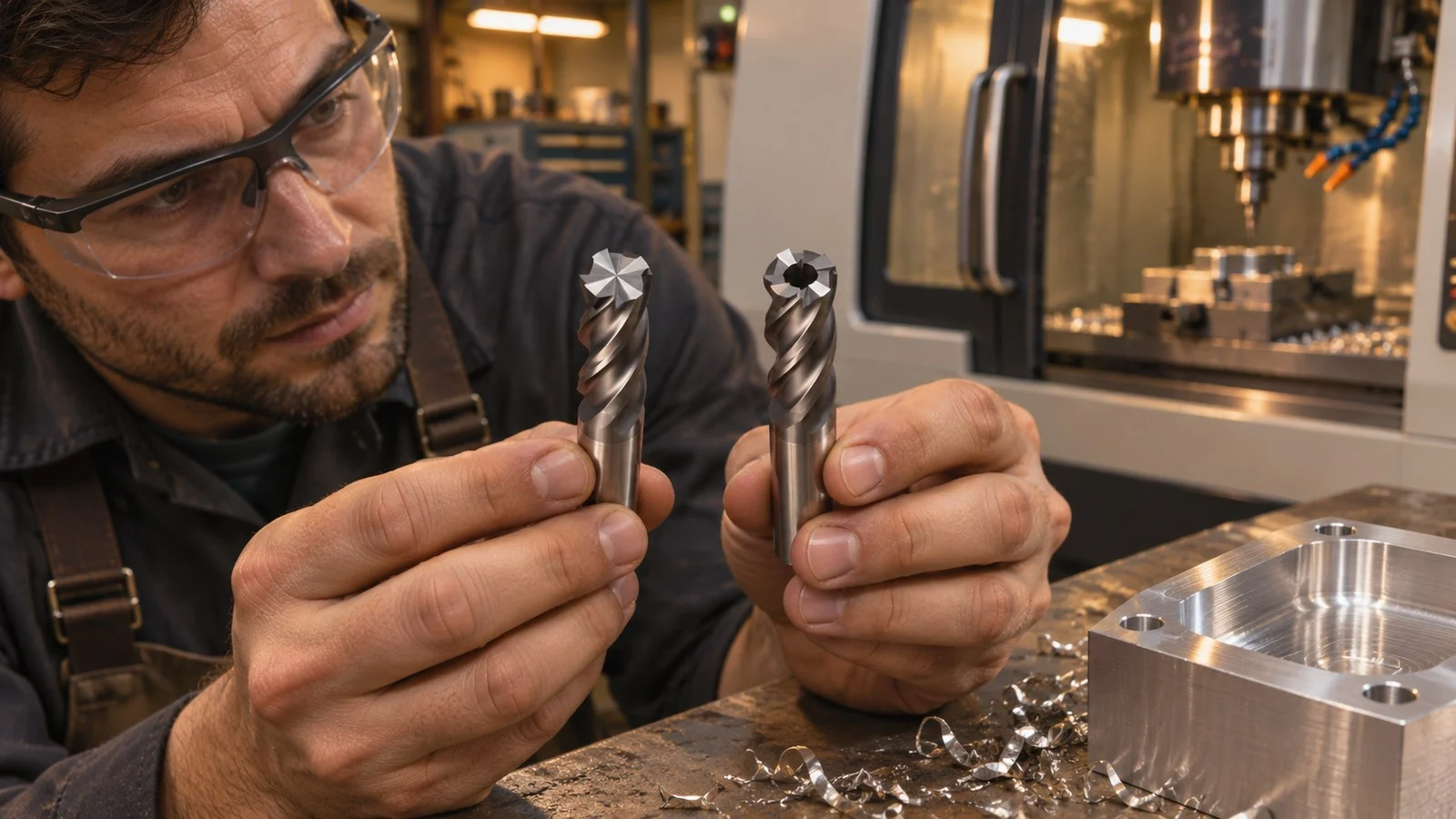
A center-cutting end mill is the choice when your operation requires a straight plunge into solid material, provided the cutter and setup are rated for that entry. A non-center-cutting end mill suits an operation that can start from the side or a suitable existing opening, subject to the cutter’s entry limits.
Center Cutting vs Non Center Cutting: Key Differences
A center-cutting end mill has a cutting edge that reaches the tool’s axis, allowing it to remove material at the center of its path. A non-center-cutting end mill leaves an area at the axis that doesn’t cut, so it shouldn’t plunge straight down into a solid workpiece.
| Difference | Center-Cutting End Mill | Non-Center-Cutting End Mill |
|---|---|---|
| End-face geometry | A cutting edge reaches the axis | A non-cutting area remains at the axis |
| Straight plunge into solid material | Possible when approved for the cutter and operation | Not suitable |
| Other entry paths | Depend on the cutter’s rated capability | Side entry or an existing opening may be possible, depending on the cutter and operation |
Center-Cutting End Mills
A center-cutting end mill has at least one end cutting edge that extends to the axis. This geometry lets the tool remove material beneath its center as it enters a workpiece.
Its advantage is the potential to plunge straight into solid material when the specific cutter and operation permit it. That can make it suitable for an entry where you can’t start from the side or use an existing opening.
The drawback is that center-cutting geometry alone doesn’t approve every entry. Plunge, ramp and helical moves can each have limits. Check the toolmaker’s rated entry capability and the machine instructions for your material, cutter, fixture and chip evacuation conditions.
Non-Center-Cutting End Mills
A non-center-cutting end mill has a non-cutting area at its axis. The end face therefore can’t remove all the material directly beneath the tool during a straight plunge into solid material.
This type can suit an operation where the cutter begins at the side of a workpiece or enters through a suitable existing opening. Match the opening and entry path to the specific cutter and operation.
Its main entry limitation is that it shouldn’t plunge straight into solid material. Don’t assume that a non-center-cutting cutter supports ramping or helical entry either; check the toolmaker’s instructions for that cutter.
Choosing an End Mill
Choose a center-cutting end mill if:
- Your operation needs a straight plunge into solid material.
- The toolmaker rates that cutter for the planned entry and cutting conditions.
Choose a non-center-cutting end mill if:
- You can use a side entry or a suitable existing opening.
- The specific cutter and operation support the planned entry path.
Before choosing a path, check the cutter’s end geometry and rated entry capability. Flute count and a generic product photo don’t confirm whether an end mill is center cutting. If you inspect a cutter already in a machine, stop and secure the machinery according to your site procedures first.
For a flat end mill option, you can view our Flat Endmill HRC50. Confirm its center-cutting status and entry limits before planning the operation.
FAQ
Can a Non-Center-Cutting End Mill Plunge?
A non-center-cutting end mill shouldn’t plunge straight down into solid material because an area at its axis doesn’t cut. A suitable side entry or existing opening may allow you to use it, depending on the cutter and operation.
Does Flute Count Indicate Center Cutting?
No. Flute count alone doesn’t establish whether an end cutting edge reaches the axis. Check the cutter’s specifications or inspect its end geometry after stopping and securing the machinery.
Can Every Center-Cutting End Mill Ramp?
No. Center-cutting geometry alone doesn’t establish that a cutter is rated for ramping. Check the toolmaker’s entry limits for the specific cutter and operation.