

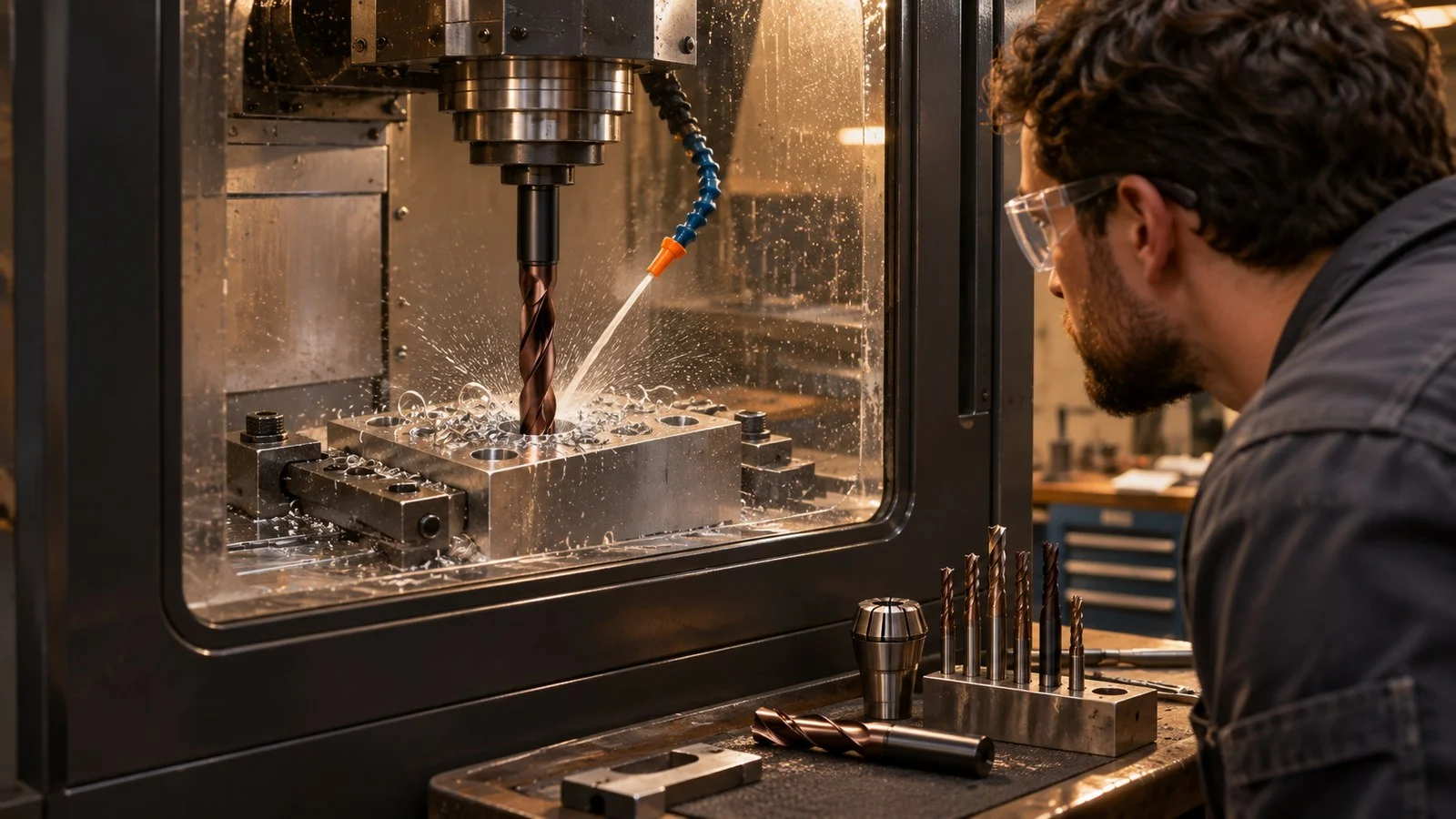
In a peck drilling vs drilling comparison, continuous drilling suits a tool and setup designed to reach depth in one feed, while peck drilling suits a tool whose recommended cycle includes retracts. The choice depends on the drill design, material, chip formation, coolant delivery, pilot-hole procedure, and controller.
Peck Drilling vs Continuous Drilling: Key Differences
Peck drilling advances the drill in stages and retracts during the hole. Continuous drilling feeds to the programmed depth before retracting. Pecking provides intervals for chip evacuation, while continuous drilling avoids those intermediate retracts. Neither motion guarantees chip control; the drill and its operating conditions determine which cycle is appropriate.
| Comparison | Peck Drilling | Continuous Drilling |
|---|---|---|
| Motion | Feeds in stages with intermediate retracts | Feeds to depth before retracting |
| Chip evacuation | Uses retracts as part of the cycle | Relies on the drill and operating conditions during the feed |
| Cycle selection | Follows a procedure that calls for pecking | Follows a procedure that permits feeding to depth without pecking |
| Cycle motion | Includes additional retract and re-entry movements | Has no intermediate peck movements |
Peck Drilling: Uses and Tradeoffs
Peck drilling breaks the feed into successive advances, with the drill retracting during the operation. Those retracts create opportunities for chip evacuation, but they also add movements to the cycle. The amount of each advance and the retract motion must match the drill’s procedure and the controller’s cycle.
Choose pecking when the drill manufacturer’s instructions call for it under your cutting conditions. For example, OSG recommends 1D–2D pecks for the conditions in its ADO-40D/50D table, while Mikron’s CrazyDrill Flex Titanium is designed for peck drilling in pure titanium and copper. These are product-specific procedures, not settings to transfer to another drill.
Continuous Drilling: Uses and Tradeoffs
Continuous drilling feeds the drill to the programmed depth before retracting. It avoids the extra movements of a peck cycle, but chip evacuation must work throughout the feed under the selected tool and coolant conditions.
Choose continuous drilling when the drill’s procedure supports it and the setup meets that procedure. Guhring’s RT100T series 6511, for example, uses a prescribed pilot-hole and through-coolant sequence followed by a feed to depth without pecking. That procedure applies to the specified drill, not every deep-hole tool.
Choosing a Drilling Cycle
Choose peck drilling if:
- The drill’s instructions call for intermediate retracts for your material and conditions.
- The specified procedure uses pecking as part of its approach to chip evacuation.
Choose continuous drilling if:
- The drill’s instructions call for a feed to depth without intermediate pecks.
- You can meet the specified pilot-hole and coolant requirements.
Before programming either cycle, check the tool’s instructions against the material, chip formation, coolant delivery, and pilot-hole procedure. If you’re reviewing our 3D drill bits, confirm the appropriate cycle for the particular drill and application. On LinuxCNC, G81 feeds to depth before retracting, while G83 adds retracts during drilling; check your own controller’s documentation before using a cycle.
FAQ
When Should I Peck Drill?
Peck drill when the drill manufacturer recommends it for the tool, material, and cutting conditions. Use the specified procedure rather than applying another drill’s peck depth.
How Does a Mill Differ From a Drill?
A drill is used to make holes, while a mill can cut along a programmed path. Select the tool for the operation and follow its cutting instructions.
How Does Tapping Differ From Drilling?
Drilling makes a hole. Tapping cuts internal threads in a hole.
How Does Driving Differ From Drilling?
Drilling makes a hole; driving turns a fastener into a material or existing hole. The two operations use different tools and purposes.