

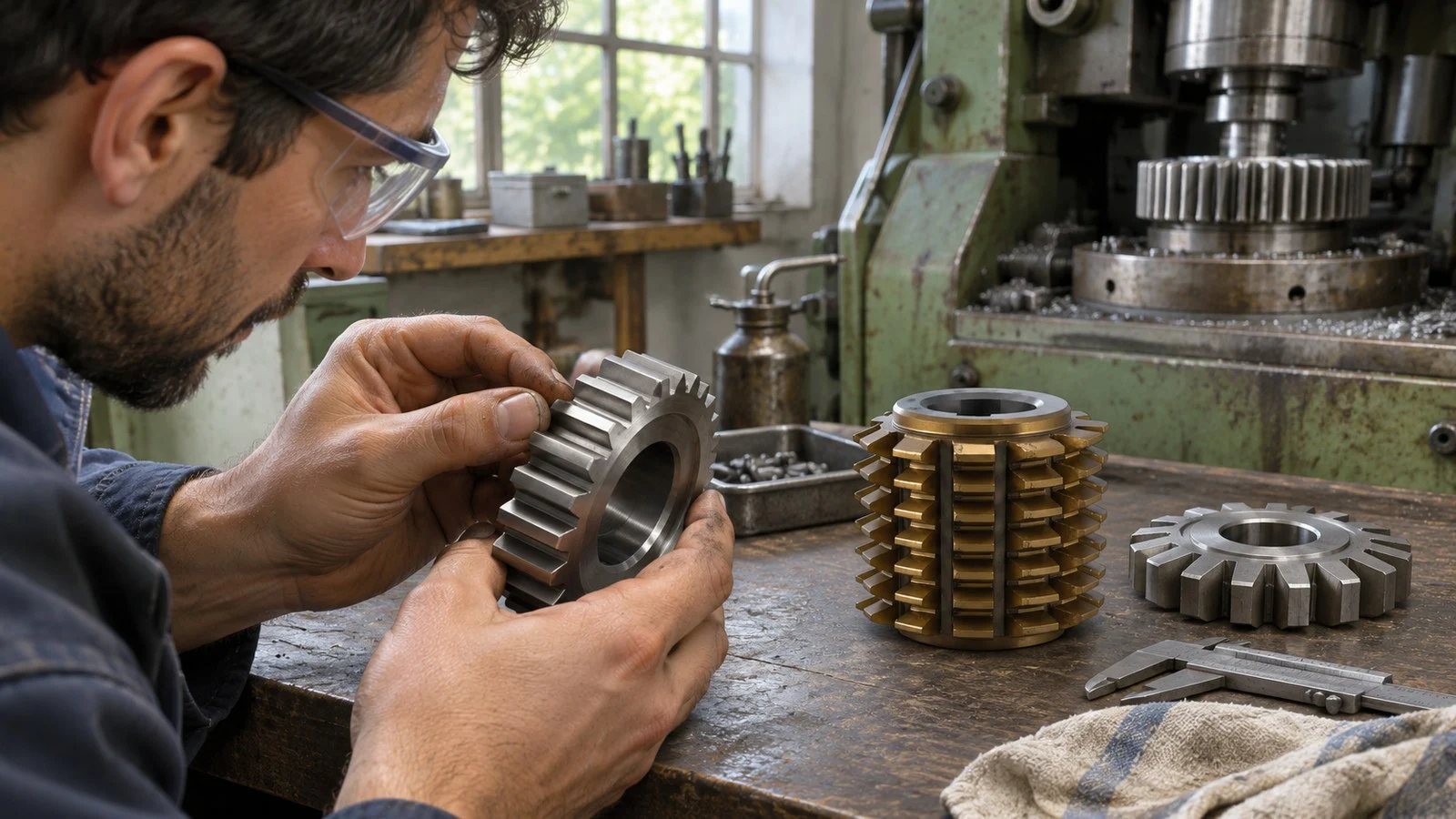
For accessible external gears, gear hobbing is often the better starting point because it cuts continuously. In the gear hobbing vs gear shaping decision, shaping is a common choice for internal teeth or gears near a shoulder, where the hob may lack clearance.
Gear Hobbing vs Gear Shaping: Key Differences
Gear hobbing uses a rotating hob and a synchronized rotating blank to generate teeth continuously. Gear shaping uses a reciprocating cutter, with the cutter and blank rotating together as the teeth are generated. Hobbing suits many accessible external gears; shaping can reach some internal teeth and restricted external features.
| Consideration | Gear Hobbing | Gear Shaping |
|---|---|---|
| Cutter motion | Rotates continuously | Reciprocates through cutting and return strokes |
| Workpiece motion | Rotates in coordination with the hob | Rotates in coordination with the cutter |
| External teeth | Common choice when the hob has access | An option when the cutter and machine suit the part |
| Internal teeth | Conventional hobbing isn’t the usual choice | A common option, subject to cutter and machine fit |
| Nearby shoulders or gears | Hob clearance and run-out can limit access | May provide access where a hob cannot, subject to cutter clearance |
| Production trade-off | Continuous cutting can favor production of accessible external gears | Reciprocating motion and return strokes affect the cycle, but geometry may make shaping the practical choice |
Gear Hobbing: Uses and Trade-Offs
Gear hobbing generates teeth with a rotating, worm-shaped hob. The hob and blank rotate in coordination while the cutter feeds along the gear face. Cutting is continuous as successive cutting edges remove material.
For an external spur or helical gear with open access, hobbing is a strong first choice. Its continuous action can make it economical for medium- to high-volume production. Browse our machining category when looking for hobbing tools.
The main drawback is access. A hob needs room to cut into and pass beyond the toothed area. A nearby shoulder, flange or adjacent gear can restrict that movement, so an external gear isn’t automatically suitable for hobbing.
Gear Shaping: Uses and Trade-Offs
Gear shaping generates teeth with a reciprocating cutter. The cutter and blank rotate together as repeated cutting strokes form the profile; the cutter also needs clearance during its return movement.
Shaping is a common option for internal teeth and for external teeth close to a shoulder or another gear. It can be useful when the part envelope prevents a hob from reaching the teeth. Disc, hub, shank and bell cutter styles offer different ways to approach a part.
The return stroke is part of the shaping cycle, and the cutter still needs room to enter, cut and clear the work. An internal profile or a tight shoulder doesn’t guarantee that a particular shaper and cutter will fit. Check the cutter style and the machine against the part drawing.
Which Gear Cutting Process Should You Choose?
Choose gear hobbing if:
- The gear has accessible external teeth.
- The hob has enough room for cut-in and run-out.
- Continuous cutting suits the planned production quantity.
Choose gear shaping if:
- The part has internal teeth and the machine and cutter can reach the profile.
- A shoulder, flange or adjacent gear restricts hob access.
- The selected cutter has enough room for its stroke and clearance.
Before committing to either process, check the part geometry with the actual machine, cutter and fixture in place. Include cut-in, run-out and clearance through the full tool movement in that review.
FAQ
Can Gear Hobbing Cut Internal Teeth?
Conventional hobbing is generally used for accessible external teeth. Gear shaping is a common option for internal teeth, although the machine, cutter and geometry must suit the part.
Is Gear Hobbing Faster Than Gear Shaping?
Hobbing cuts continuously and can be economical for accessible external gears. Actual cycle time depends on the part, tooling, machine and setup, so neither process is always faster.
Can Gear Shaping Cut Near a Shoulder?
Gear shaping can reach some teeth near a shoulder where a hob lacks room. The cutter still needs adequate clearance for cutting and its return stroke.