

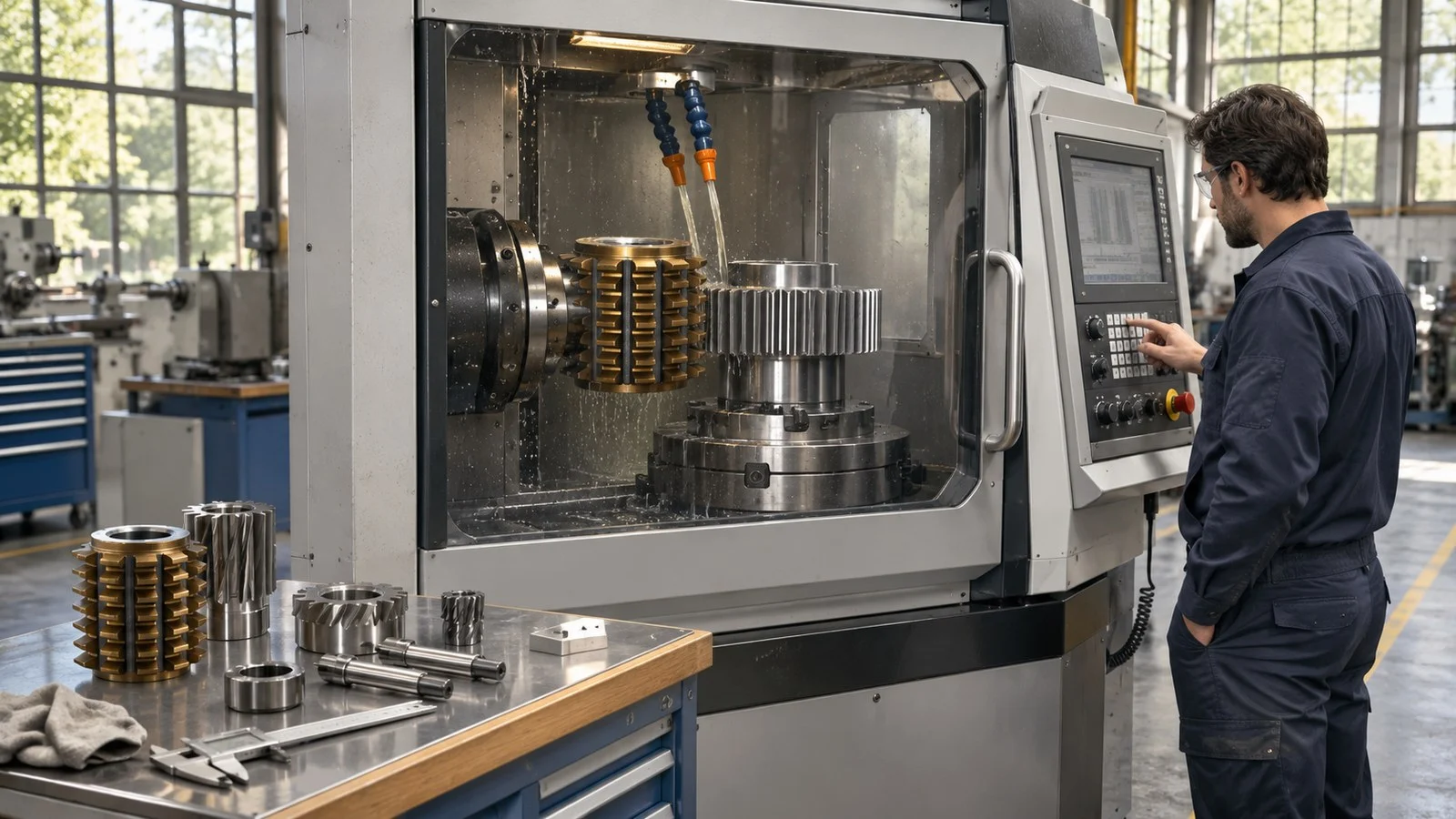
Set gear hobbing speeds and feeds by choosing a cutting speed suited to the hob and workpiece materials, converting it to hob rpm, and entering axial feed in the units required by the machine. Hob rpm and workpiece rpm are separate settings; axial feed per workpiece revolution also differs from feed per hob revolution.
How to Set Gear Hobbing Speeds and Feeds
Start with the cutting conditions specified for the hob and workpiece. Use the hob’s outside diameter to convert the selected surface speed into hob rpm. Set axial feed using the machine’s required unit, then follow the machine instructions for synchronizing the hob and workpiece.
The main quantities have different jobs:
| Quantity | What it describes | Typical metric unit |
|---|---|---|
| Cutting speed | Surface speed at the hob’s outside diameter | m/min |
| Hob speed | Hob rotation | rpm |
| Workpiece speed | Gear blank rotation | rpm |
| Axial feed | Travel along the gear face per workpiece revolution | mm/workpiece rev |
| Radial feed | Movement toward the required tooth depth | Machine-dependent |
Choose the cutting speed with both hob material and workpiece material in mind. For the actual setting, follow the tool and machine instructions and the requirements for the gear being cut.
Calculate Hob RPM From Cutting Speed
Hob diameter connects surface speed and spindle speed:
Cutting speed (m/min) = π × hob outside diameter (mm) × hob rpm ÷ 1,000
Rearrange the equation to find the spindle setting:
Hob rpm = cutting speed (m/min) × 1,000 ÷ (π × hob outside diameter in mm)
For example, a surface speed of 60 m/min with a 100 mm outside-diameter hob gives approximately 191 rpm. Those numbers illustrate the calculation; they aren’t a recommended cutting condition.
At the same surface speed, a larger hob requires fewer rpm than a smaller hob. Check the outside diameter used for the calculation against the actual tool before entering the spindle speed.
Keep Hob RPM and Workpiece RPM Separate
The hob spindle rotates the cutter; the work spindle rotates the gear blank. The machine coordinates these motions to generate the teeth, so the two rpm values shouldn’t be treated as interchangeable.
The relationship depends on hob starts, gear geometry and machine setup. Helical gears also require the applicable differential compensation. Use the machine’s instructions for the job rather than applying a simplified indexing ratio to every gear.
Set Axial Feed in the Correct Unit
Axial feed describes how far the hob travels along the gear face. When expressed in mm/workpiece revolution, it is the axial distance traveled during one turn of the gear blank. Feed per hob revolution uses a different reference and can’t be entered as the same number without conversion.
If the machine requires an axial feed rate in mm/min, multiply the feed in mm/workpiece revolution by the workpiece speed in rpm:
Axial feed (mm/min) = feed (mm/workpiece rev) × workpiece rpm
For example, at 0.5 mm per workpiece revolution and 20 workpiece rpm, the axial travel rate is 10 mm/min. This is a unit example, not a process recommendation. Confirm which feed unit the control requests before entering a value.
Radial feed serves a different movement: it controls travel toward the tooth depth. Don’t substitute a radial feed setting for the axial feed along the gear face.
Check the Setup Before Cutting
Before starting, record the hob outside diameter, the specified cutting speed, the calculated hob rpm and the axial feed with its unit. Check the gear requirements and machine setup, including any helical differential, against the machine instructions. Select cutting oil and flow according to the tool and machine suppliers.
If you’re reviewing tooling for the job, our machining category provides a place to browse hobbing tools. Use the actual tool’s instructions when setting its cutting conditions.
FAQ
Is Hob RPM the Cutting Speed?
No. Hob rpm is rotational speed; cutting speed is the surface speed at the hob’s outside diameter. Calculate one from the other using the hob diameter.
Is Axial Feed per Hob Revolution?
Axial feed can be expressed per workpiece revolution. Check the machine’s required unit: a value per workpiece revolution isn’t the same as a value per hob revolution.
Does a Larger Hob Need More RPM?
At the same cutting speed, a larger outside diameter requires fewer rpm. Use the actual hob diameter and the cutting speed specified for the job.