

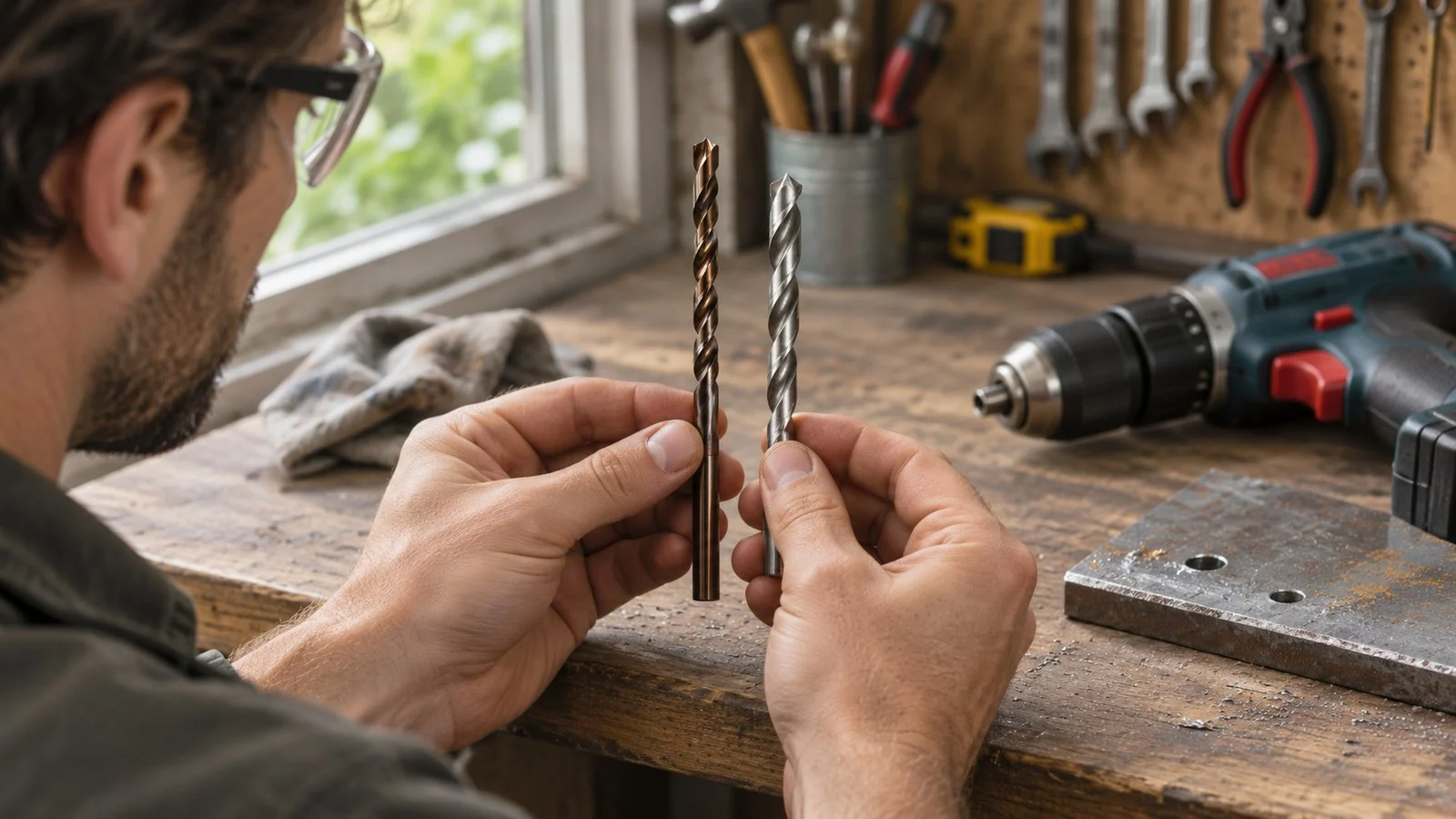
For most hand-drilling jobs, M35 is a practical starting choice because it’s less susceptible to shock. When you can maintain a consistent setup and the job places greater demands on heat or abrasion resistance, evaluating M42 may be worthwhile. The choice between M35 vs M42 cobalt drill bits also depends on the workpiece, drill geometry and machine setup.
M35 vs M42: Key Differences
M35 and M42 are cobalt-bearing high-speed steel grades. M35 contains nominally about 5% cobalt, while M42 contains about 8%; their other alloy contents differ too. M35 is generally the starting point where shock is a concern, while M42 is worth evaluating for demanding heat and abrasion conditions under controlled drilling.
| Consideration | M35 | M42 |
|---|---|---|
| Nominal cobalt content | About 5% | About 8% |
| Heat and abrasion | Offers heat and abrasion resistance | Worth evaluating where heat and abrasion demands are greater |
| Shock considerations | Less susceptible to shock | Calls for particular attention to setup control |
| Typical starting point | Hand drilling and other jobs where control may vary | Controlled drilling where heat or abrasion is a concern |
Neither grade designation guarantees how a finished drill will perform. Heat treatment, geometry, drill size, workpiece material, machine and setup all affect the result.
M35 Drill Bits: Strengths and Uses
M35 is a high-speed steel grade with cobalt alloyed throughout the material. It offers resistance to heat and abrasion and can be used for metal-drilling applications that include stainless steel.
M35 is a sensible starting point when you’re drilling by hand or expect some variation in alignment and feed control. Its drawback is that a demanding, consistently controlled job may justify evaluating M42 for its heat and abrasion characteristics.
The workpiece still matters: stainless steel covers different grades and conditions, so check the drill’s suitability for your specific job. Our M35 Straight Twist Drill (HSS) is an option to review when selecting an M35 drill.
M42 Drill Bits: Strengths and Uses
M42 is a different cobalt-bearing high-speed steel grade with nominally about 8% cobalt. Its heat and abrasion resistance makes it worth evaluating for more demanding drilling conditions.
The tradeoff is greater concern about shock, so a consistent setup is especially useful. A drill press or another controlled machine setup can help you maintain alignment and speed. M42 can be used by hand, but the grade alone doesn’t guarantee a better result or longer drill life.
Which Cobalt Drill Bit Should You Choose?
Choose M35 if:
- You’re drilling by hand and want a starting grade that’s less susceptible to shock.
- Your application calls for a cobalt HSS drill, but the setup may be difficult to control consistently.
Consider M42 if:
- You can maintain a consistent drilling setup.
- Heat or abrasion places greater demands on the drill and you want to evaluate another grade for the job.
Before selecting either, check the actual workpiece grade and condition, hole size, machine and workholding. Compare the drill’s geometry and heat treatment as well as its steel grade. A coating and a point angle are separate choices: neither tells you whether the underlying HSS is M35 or M42.
FAQ
Is M42 Harder Than M35?
The grade names alone don’t establish the hardness of a finished drill. Heat treatment and the particular tool matter, so compare the manufacturer’s specifications for the drills you’re considering.
Is Cobalt a Coating on Drill Bits?
In M35 and M42 cobalt HSS, cobalt is part of the steel alloy. A drill may also have a separate coating, but the M35 or M42 designation identifies the underlying steel grade.
Can You Use M42 by Hand?
Yes, M42 can be used in a hand drill. Pay attention to alignment and control; M35 is often the more practical starting choice when hand-drilling conditions are less consistent.