

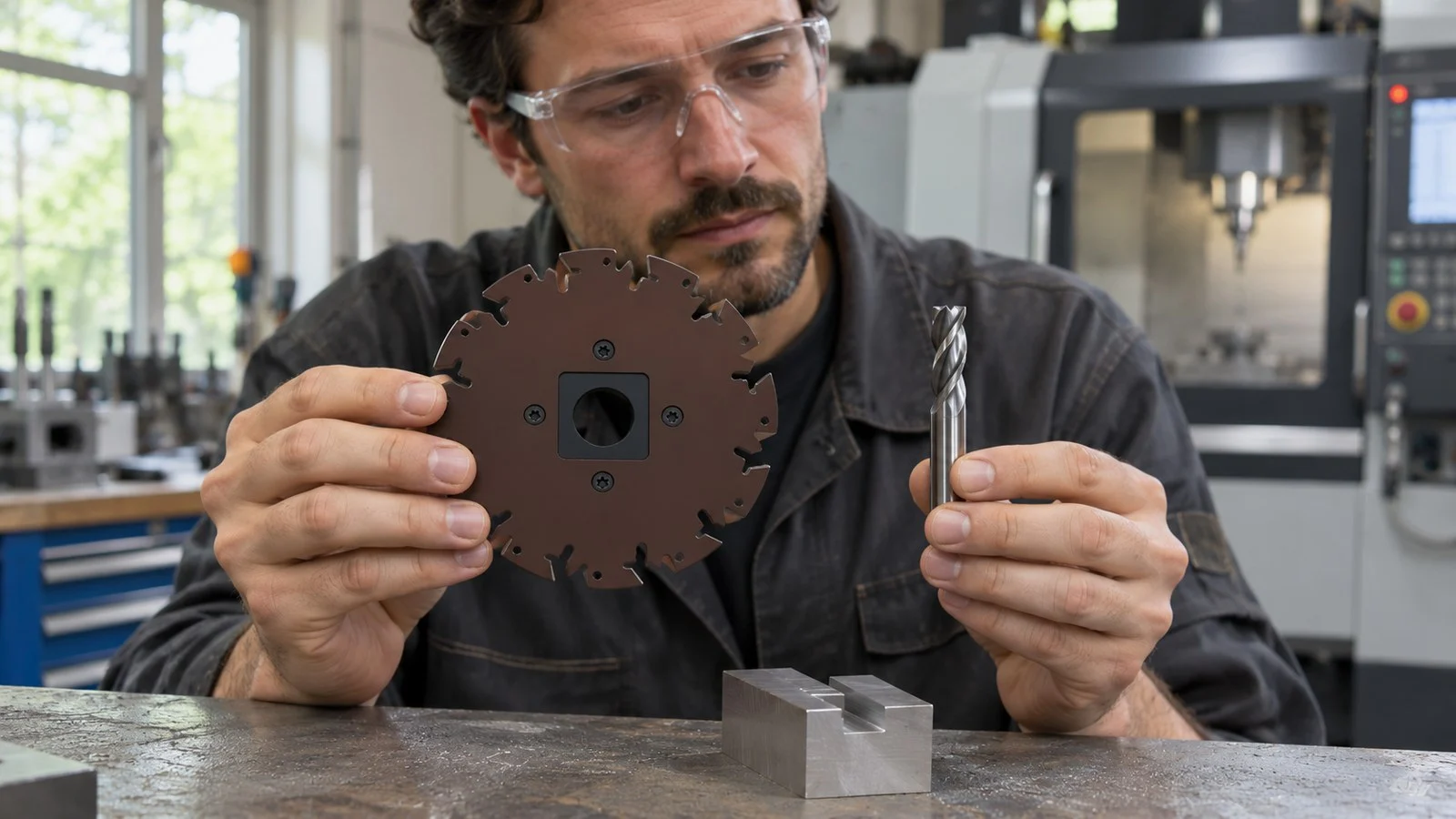
For a narrow slot or cutoff with open side access, a slitting saw is usually the better starting choice. In a slitting saw vs end mill comparison, an end mill makes more sense when you need to machine an accessible pocket or change the cutting path.
Slitting Saw vs End Mill: Key Differences
A slitting saw uses a thin circular cutter mounted on an arbor, making it suited to narrow grooves and cutoff work with suitable side access. An end mill offers more path flexibility for accessible pockets and complex shapes. The choice also depends on slot depth, machine orientation, clearance, chip evacuation, and setup rigidity.
| Selection factor | Slitting saw | End mill |
|---|---|---|
| Typical work | Thin slots and cutoff | Shallow grooves, accessible pockets, and complex paths |
| Slot width | Cutter width is a starting point for selection | Tool size and programmed path affect the slot geometry |
| Deep, narrow grooves | Arbor-supported disc may offer a stability advantage when access permits | A long overhang can increase deflection and chatter |
| Access | Needs clearance for the disc, arbor, and holder | Must be able to reach and follow the required path |
| Path flexibility | Well suited to a slot or cutoff accessible from the side | Better suited to changing paths and more complex shapes |
Slitting Saw: Strengths and Limits
A slitting saw is a circular cutter with teeth around its edge, mounted on an arbor. Its thin blade suits narrow slots and cutoff work, and an arbor-supported disc can be advantageous when a groove is narrow relative to its depth.
The tradeoff is clearance. The disc, arbor, and holder all need room to reach the cut without hitting the workpiece or fixture. Disc diameter and the setup can also limit the usable cutting depth. Check the entire swept envelope, not just the blade edge. For a relevant catalog option, our Saw Blade Milling Cutter page is a starting point; check the cutter and holder details against your setup before selection.
End Mill: Strengths and Limits
An end mill is a versatile choice for shallow grooves, accessible pockets, and shapes that call for changes in the tool path. It can be practical when several features can be reached with one tool and setup efficiency matters.
For a narrow, deep groove, reaching the bottom may require a long overhang. That can make deflection, chatter, and dimensional error more likely. Check the tool geometry and access before planning an entry move: not every end mill is suitable for plunging.
Which Slotting Tool Should You Choose?
Choose a slitting saw if:
- You need a thin slot or cutoff and can approach it from the side.
- The disc, arbor, and holder can clear the workpiece and fixture throughout the cut.
- A supported disc is practical for the depth and width of the groove.
Choose an end mill if:
- You need to follow a changing path or machine an accessible pocket.
- The groove is shallow enough for a suitable tool with a manageable overhang.
- One tool can reach the required features without an unsuitable entry move.
Before cutting, check machine orientation, workholding clearance, and how chips will leave the slot. Treat cutter width as a starting point rather than a guaranteed finished width: cutter geometry, runout, and deflection affect the result, so measure the slot against its requirement.
FAQ
Can a Slitting Saw Cut a Pocket?
A slitting saw can only reach the areas allowed by the cutter, arbor, holder, and surrounding geometry. An end mill is often more flexible for an accessible pocket with a changing path.
Is a Slitting Saw Better for Narrow Slots?
A slitting saw is a good starting choice for a thin slot when side access and clearance are available. Check the required depth, chip evacuation, and the space needed by the whole assembly.
Can Every End Mill Plunge Into Material?
No. Whether an end mill can plunge depends on its cutting geometry and the available access. Confirm the tool’s suitability before choosing the entry move.