

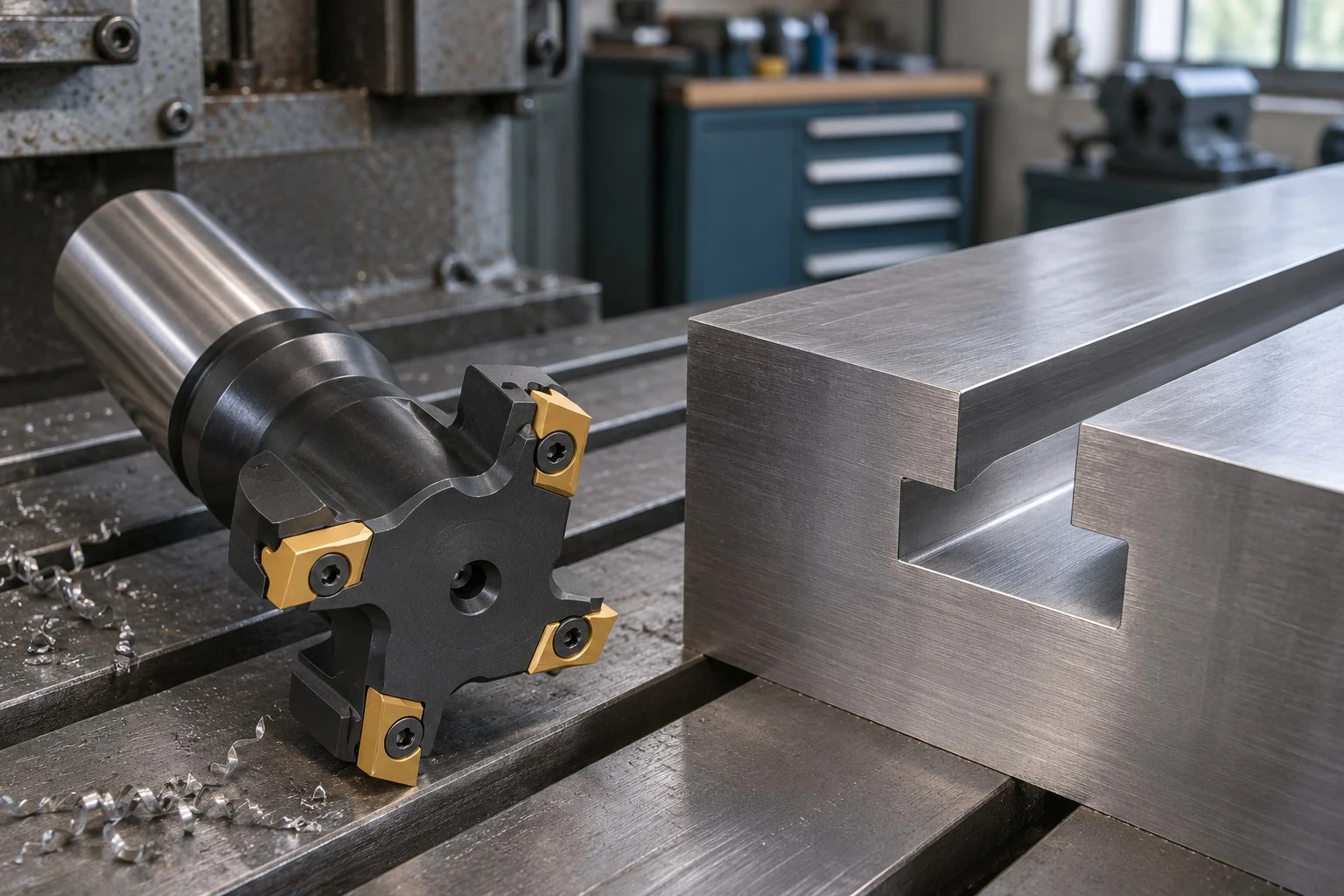
An indexable T slot milling cutter can reduce tool changes and provide replaceable cutting edges, but the cutter must match the slot, workpiece, and machine setup. Selection starts with the drawing and the manufacturer’s dimensional data. A cutter that fits the nominal slot width may still be unsuitable if its neck, reach, cutting diameter, or insert arrangement conflicts with the part or fixture.
Start With the Slot Drawing
Identify the slot width, undercut width, depth, entry opening, and available approach path. A typical T slot has a narrower opening above a wider undercut, but dimensions and corner details vary by design. Confirm which dimensions are finished requirements and which allow machining clearance.
Check whether the cutter can enter through the opening and reach the undercut without colliding with the workpiece or fixture. The neck or shank must clear the slot opening, while the cutting portion must cover the required width. Compare the tool drawing with the complete part geometry, not just a single width callout. Include any runout, shoulder, and corner-clearance requirements in the review.
Match Cutter Geometry to the Operation
Determine whether the operation is roughing, finishing, or both. Roughing may prioritize chip space and stable cutting; finishing may require attention to the cutting edge arrangement and the surface specified by the drawing. The cutter maker’s catalog should state the intended use, compatible insert types, and dimensional limits.
Review the cutter diameter, neck dimensions, overall reach, and cutting width. A longer reach can be necessary to access a deep slot, but excessive overhang can reduce rigidity and increase vibration risk. Choose the shortest assembly that reaches the feature with safe clearance. If the slot has a blind end, check whether the cutter can reach its full depth without the shank or shoulder contacting the part.
An indexable cutter also depends on insert compatibility. Confirm the approved insert shape, size, grade, edge preparation, and orientation for the body. Do not select a substitute based only on a similar appearance or a matching screw hole. The manufacturer’s compatibility chart and instructions are the authority for insert selection and installation.
Check the Machine and Setup
Confirm spindle interface, available power, speed range, toolholding, and machine clearances. Check that the assembled cutter fits the toolholder and that the holder can reach the feature without interference. Account for fixture clamps, nearby walls, and the machine enclosure. Consider the tool assembly’s balance and the machine maker’s limits, especially when the cutter has a long projection.
Plan workholding and cutter engagement. The workpiece needs enough support to resist cutting forces without shifting. A narrow or poorly supported wall beside the slot may deflect, even when the cutter is dimensionally suitable. Consider the tool path, approach and exit, and whether the operation can maintain a stable engagement. Follow machine instructions for loading, clamping, offsets, and spindle startup.
Verify Cutting Data and Maintenance Needs
Use the cutter and insert manufacturers’ recommended starting data for the specific material and operation. Do not transfer speeds, feeds, or depth-of-cut values from a different cutter family without checking compatibility. Material condition, machine rigidity, holder, coolant, and engagement all affect the result.
Before the first production run, verify insert seating, screw condition, and cutter-body integrity. Replace questionable components only with specified parts. During a trial cut, monitor chip formation, sound, vibration, and slot dimensions. If the result is unstable, stop and inspect the setup rather than compensating blindly with offsets or higher cutting data.
For procurement, provide the supplier with the slot drawing, material, machine and holder details, required reach, operation type, and expected production context. This makes it easier to identify a compatible system and clarify any limits before purchase.
FAQ
Can a standard end mill machine a T slot?
Some slot features may be machined in stages with other tools, but the correct sequence depends on the part and drawing. Choose tooling based on the required geometry and manufacturer guidance.
Is a wider cutter always better?
No. It must fit the undercut and provide the intended coverage while clearing the opening, neck, workpiece, and fixture.
Where can I learn about Wencerl?
Wencerl supplies metal cutting tools. Visit Wencerl for company information and its tooling range.