

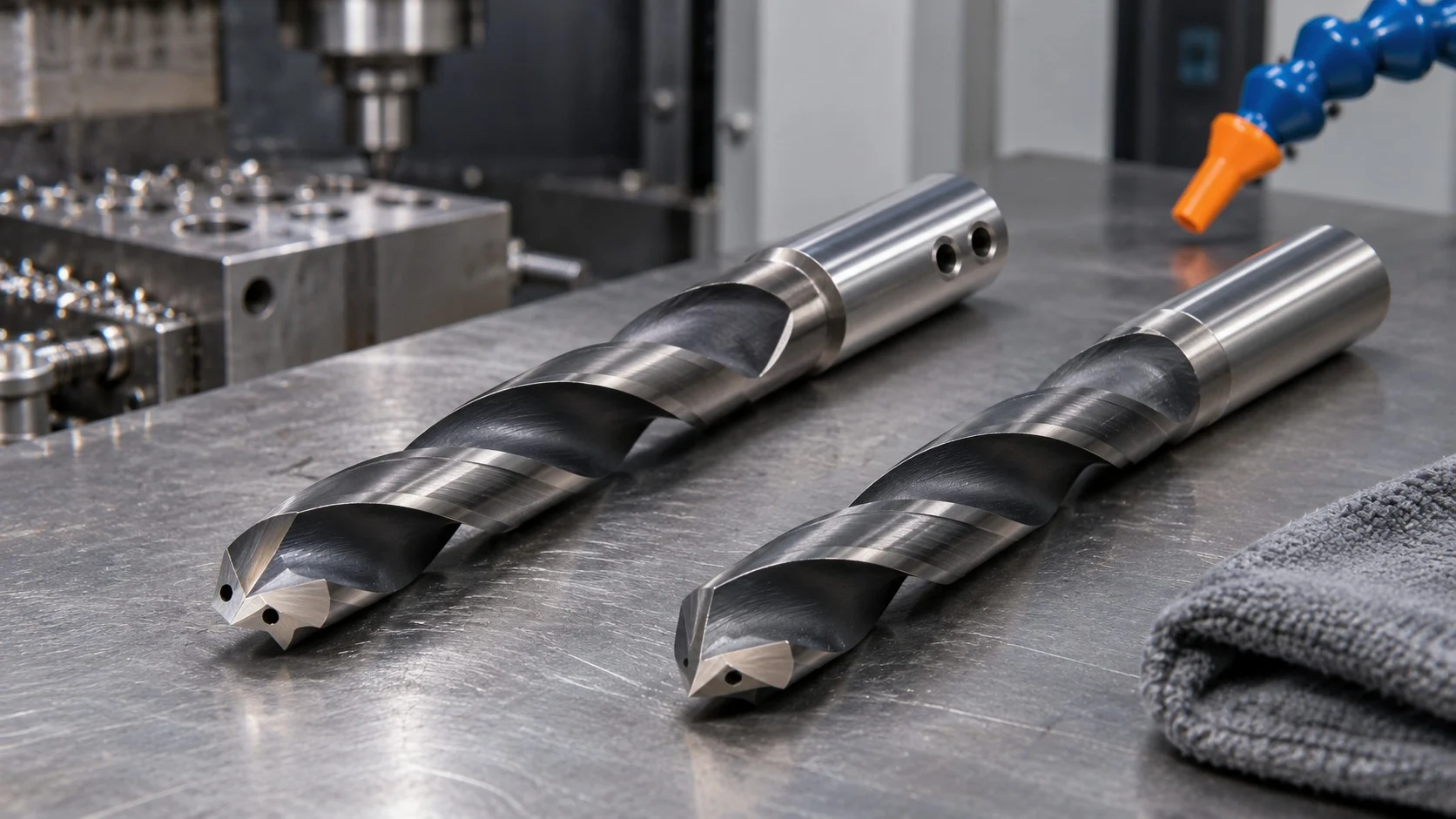
Choosing between internal and external coolant delivery affects how heat and chips are managed during drilling. With external coolant, fluid reaches the cutting area from nozzles outside the tool. With internal coolant, fluid travels through passages in the drill and exits near the cutting edges. The better choice depends on hole depth, material, drill design, machine capability, and the manufacturer’s operating guidance.
How External Coolant Works
External coolant is directed toward the drill from one or more machine nozzles. It can be practical for general drilling where the hole is shallow enough for fluid to reach the cutting edges and chips can escape along the flutes. Nozzle position and flow matter: a jet that misses the drill point or is blocked by the workpiece may provide little benefit at the cutting zone.
This method does not require a coolant-through tool or a spindle supply connection. It may suit machines without internal coolant delivery, provided the operation remains within the drill maker’s limits. However, as the drill enters a deeper hole, the tool can obstruct coolant access and make chip removal more difficult. The risk depends on the geometry, material, depth, and cutting conditions, so use the tool manufacturer’s recommendations rather than a universal depth rule.
How Internal Coolant Works
Internal coolant drill bits route coolant through passages in the tool body to outlets near the cutting edges. This can deliver fluid closer to the cutting zone and help move chips out of the hole when the drill and operation are designed for it. The exact benefit depends on the tool geometry, coolant supply, material, and setup.
Internal coolant requires compatible equipment. Verify that the machine or toolholder supplies coolant through the required path and that pressure, flow, filtration, and coolant type meet the drill manufacturer’s specifications. Check seals and connections, and confirm that the coolant passages are clean. A through-coolant drill used without a suitable supply may not perform as intended, and blocked passages can prevent effective delivery.
Choose for Hole Depth and Chip Control
Start with the hole drawing: diameter, depth, tolerance, finish, entry surface, and whether the hole is blind or through. Then consider the workpiece material and chip behavior. Long or stringy chips can be difficult to clear; short chips may evacuate more readily, but the actual result depends on the tool and cutting conditions.
For a shallow hole with open chip evacuation and a machine that lacks through-tool delivery, external coolant may be a reasonable option if the drill maker permits it. For deeper holes or operations where chip evacuation is a concern, internal delivery may be advantageous when the drill, holder, and machine support it. These are selection considerations, not guarantees. Some drill designs require a particular coolant method or pecking cycle, while others permit more than one approach.
Avoid assuming that adding more coolant alone will solve a chip problem. Check drill geometry, flute condition, runout, feed, speed, and the programmed cycle. Follow machine instructions for coolant pressure, spindle operation, and safe tool changes. Never open a pressurized coolant connection until the system is shut down and depressurized according to the machine procedure.
Validate the Setup Before Production
Use the tool manufacturer’s starting data for the selected drill and material. Confirm that the drill is suitable for the hole depth and that the holder, coolant supply, and machine all meet its requirements. Run a controlled trial and inspect chips, hole dimensions, tool condition, and coolant delivery. Stop if there is unusual noise, poor evacuation, or signs of tool damage.
Keep both tool and machine specifications available for the operator. Record the coolant method, connection, and cycle that worked for the specific setup so the process can be repeated safely. For a Wencerl tooling overview, visit Wencerl, a supplier of metal cutting tools.
FAQ
Does internal coolant always produce better holes?
No. Results depend on the drill design, coolant delivery, material, machine, and cutting conditions. Use the tool maker’s guidance and verify the process.
Can external coolant be used for a deep hole?
It depends on the drill and operation. Check the manufacturer’s limits and required cycle rather than relying on a general depth threshold.
What should I check first if chips are not clearing?
Stop and review the drill condition, coolant direction or supply, chip control, and programmed cycle against the manufacturer’s instructions.