

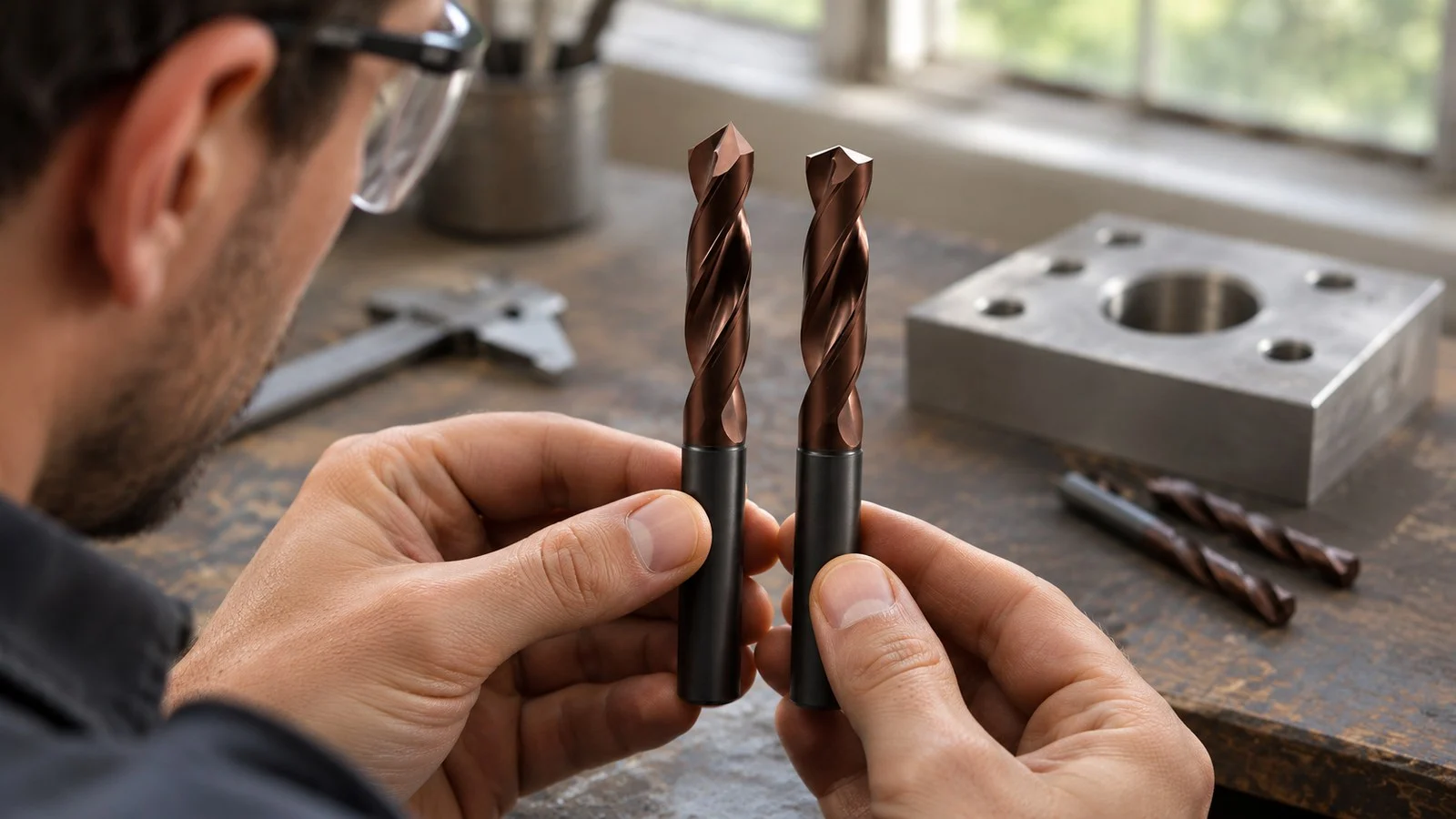
In a 118 vs 135 drill angle comparison, choose a 118° point when a longer, more pointed tip fits the hole requirements; choose a 135° point when a flatter tip with less axial point height is useful. Check the complete drill geometry and toolmaker’s recommendations before choosing for a specific material or job.
118 vs 135 Drill Angle: Key Differences
The 118° and 135° drill angles measure the included angle at the tip. At the same drill diameter, a conventional 118° point is more pointed and has a longer axial point height; a conventional 135° point is flatter and shorter. Either angle can be made with a split-point geometry.
| Comparison | 118° Point | 135° Point |
|---|---|---|
| Included angle | 118° | 135° |
| Conventional point shape | More pointed | Flatter |
| Axial point height at equal diameter | Longer | Shorter |
| Split-point availability | Available | Available |
| Selection | Consider when a longer point fits the hole requirements | Consider when a shorter point fits the hole requirements |
These differences describe the point shape, not the performance of every drill. The cutting edges, web and other features also matter, so the angle alone doesn’t tell you how a drill will center, wear or perform in a given material.
118° Drill Points: Uses and Tradeoffs
A 118° drill point has a narrower included angle. For conventional points of equal diameter, its longer tip may suit a job where that point shape fits the available depth and the required hole profile.
The longer point also means that the tip extends farther axially than a conventional 135° point of the same diameter. Account for that shape when depth or clearance at the bottom of a hole matters. A 118° point can be conventional or split, so check the individual drill’s geometry before specifying it.
135° Drill Points: Uses and Tradeoffs
A 135° drill point has a wider included angle. Its shorter conventional tip can be useful when the axial length of the point matters to the hole profile or available depth.
The flatter shape alone doesn’t guarantee easier starting, lower thrust, longer tool life or better results in a particular material. A 135° point can also have different edge and web designs, including a split point. Check the complete specification rather than selecting the angle as a proxy for those features.
Point Angle and Split Points
The included angle describes the angle across the drill tip. A split point describes a feature of the tip’s cutting geometry. They are separate choices: Hannibal Carbide lists both 118° and 135° split-point designs.
When comparing drills, check whether each one has a split point or other web treatment as well as its included angle. A comparison between one 118° drill and one 135° drill may reflect several design differences at once.
Which Drill Point Angle Should You Choose?
Choose a 118° point if:
- A longer conventional point fits the required hole profile and available depth.
- The toolmaker specifies a 118° drill for your material and operation.
Choose a 135° point if:
- A shorter conventional point helps meet the hole profile or depth requirement.
- The toolmaker specifies a 135° drill for your material and operation.
Before ordering, verify the point angle, point design and application limits for the exact drill. If you’re also considering our 3D drill bits, check the individual product specifications for the point geometry and recommended use.
FAQ
Is a 135° Drill Point Always Split?
No. A 135° included angle and a split point describe different features. Check the specification for the particular drill.
Can a 118° Drill Have a Split Point?
Yes. Split-point designs are available with a 118° included angle.
Is a 135° Point Always Better?
No. A 135° conventional point is flatter and shorter than a 118° conventional point of the same diameter, but angle alone doesn’t establish which drill will perform better in your operation.