

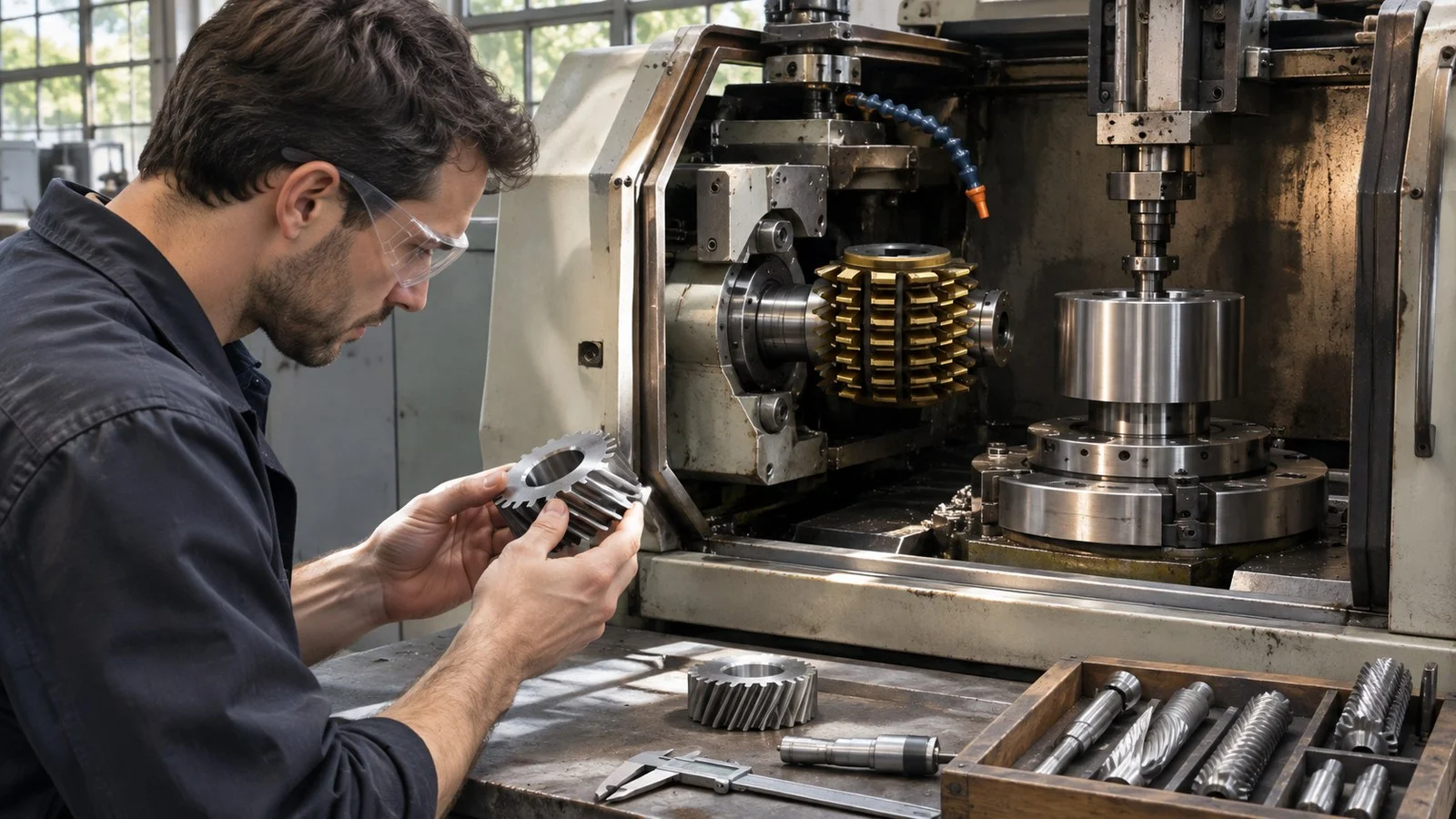
In gear hobbing climb vs conventional, climb hobbing is worth considering when tool life is the priority, while conventional hobbing is a candidate when finish or cutting stability matters most. Those are general tendencies, not guarantees: use the machine manual and a qualified setup to establish which approach suits the job.
Gear Hobbing Climb vs Conventional: Key Differences
In axial gear hobbing, the hob and workpiece rotate in synchronization while the hob feeds across the gear face. EIFCO’s feed-direction description defines conventional feed as aligned with cutting motion and climb feed as opposite to it. Those relationships use a cutting reference frame, not a universal machine up or down command.
| Consideration | Climb Hobbing | Conventional Hobbing |
|---|---|---|
| Feed relative to cutting motion | Opposite | Aligned |
| Tool life | May be favored | May be less favorable |
| Surface finish | May be less favorable | May be favored |
| Cutting stability | Assess for the setup | Often considered for stability |
| Machine travel | Depends on the setup and reference frame | Depends on the setup and reference frame |
Hob rotation, workpiece rotation and axial feed are three separate motions. The first two must remain synchronized; the third moves the hob across the gear face. Machine layout, hob handedness and the way directions are referenced all matter when translating the comparison into a setup.
Climb Hobbing: Strengths and Limitations
Climb hobbing feeds the hob opposite to the cutting motion in the reference frame described above. It may offer better tool life, making it a useful option to evaluate when hob wear is a priority.
The tradeoff is that conventional hobbing may produce a better finish. Cutting forces and stability also need to be assessed for the particular machine and setup; don’t assume that a tool-life benefit will appear on every job.
Conventional Hobbing: Strengths and Limitations
Conventional hobbing feeds the hob in the same direction as the cutting motion in that reference frame. It may be a useful choice when the required finish or cutting stability takes priority.
The tradeoff is that climb hobbing may provide longer tool life. Compare the resulting wear and finish for the job, and follow the machine manual and qualified setup instructions when choosing the approach.
Choosing an Axial Hobbing Direction
Choose climb hobbing if:
- Tool life is the leading concern and the hob, machine and gear geometry support the approach.
- The expected finish and cutting behavior meet the job’s requirements.
Choose conventional hobbing if:
- Finish or cutting stability is the leading concern and the hob, machine and gear geometry support the approach.
- The expected tool wear is acceptable for the job.
Before changing an existing setup, verify the permitted approach and synchronization instructions for the machine. If you’re checking a hob for a job, our Gear hob m2 a20°A listing identifies the product; confirm its handedness, gear profile and machine compatibility before selecting a feed direction.
FAQ
Is Climb Hobbing Always Upward?
No. Upward or downward travel depends on the machine layout, handedness, reference frame and setup. Climb describes the feed relationship to cutting motion in the stated reference frame.
Does Conventional Hobbing Give Better Finish?
Conventional hobbing may give a better finish, but the result depends on the actual process. Check the finish against the requirements of the job.
Can I Reverse the Feed Direction?
Only after confirming that the hob, machine and gear geometry support the intended approach. Follow machine-specific setup and synchronization instructions; don’t change rotation or feed direction based on a general comparison.