

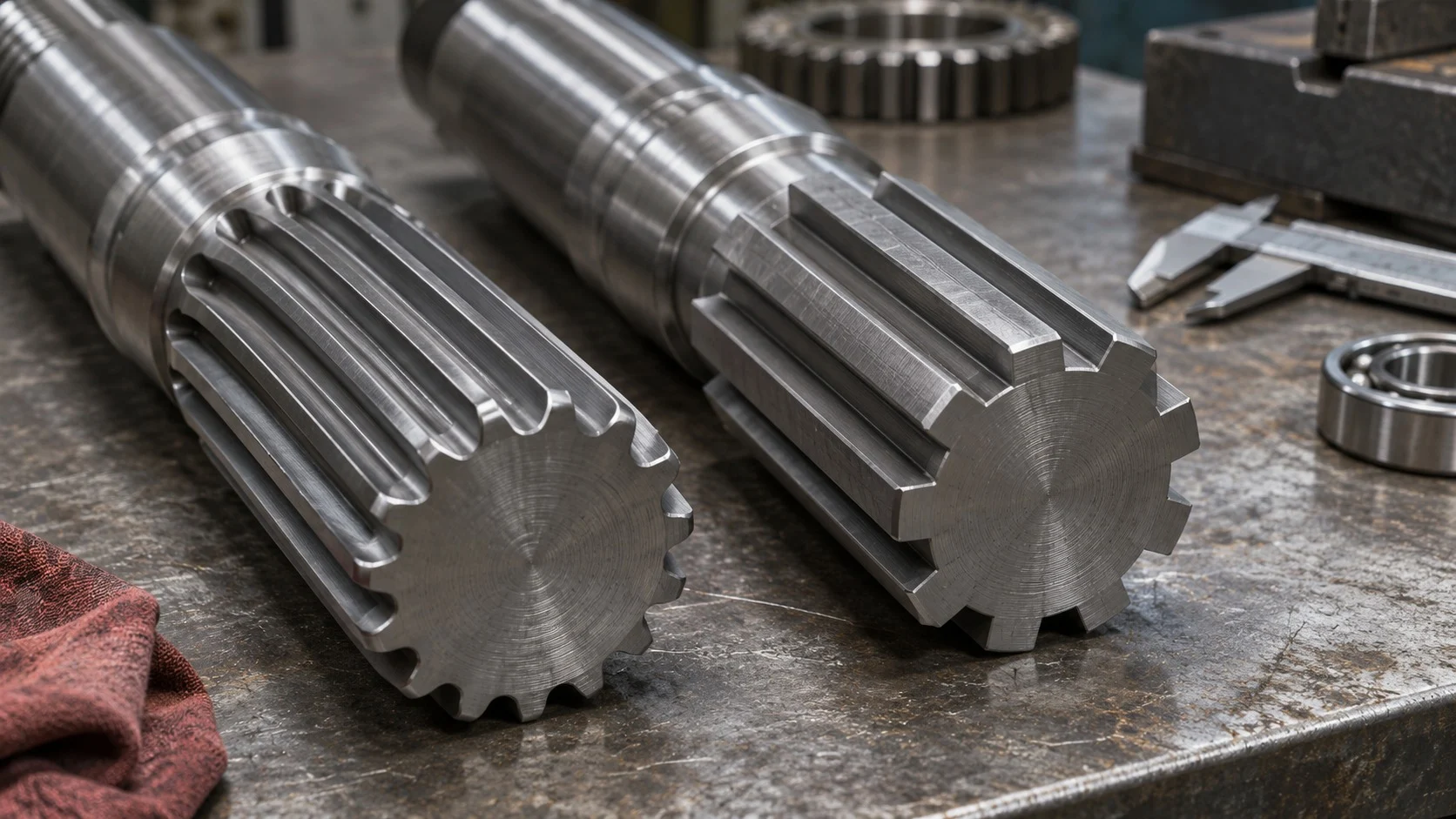
Involute and straight sided splines both connect a shaft to a mating hub, but their tooth forms and fit requirements differ. Choosing a cutter or inspection method from the spline name alone is risky: the drawing must define the standard, dimensions, tolerances, fit, and functional requirements. Use the comparison below to frame the selection, then confirm the details against the governing standard and component specifications.
Compare the Tooth Forms
An involute spline has tooth flanks based on an involute profile. The form is related to gear tooth geometry, and the specified pressure angle and other system details influence the flank shape. Depending on the design and fit, contact can occur along the flanks, and the geometry can help accommodate small alignment deviations. That does not mean every involute spline self-centers or shares load equally; actual behavior depends on tolerances, fit, stiffness, and assembly conditions.
A straight sided spline has flanks that are straight in the axial section of the tooth profile, with parallel-sided geometry defined by its applicable system. Its dimensions and fit are controlled by the relevant standard or drawing. Avoid treating “straight sided” as a complete specification, since several dimensional and tolerance choices determine whether parts will mate correctly.
Consider Fit, Load, and Assembly
The required fit is central to spline selection. A sliding connection may need controlled movement, while a fixed connection may prioritize location and torque transfer. The selected fit affects clearance, assembly force, backlash, and how the mating surfaces contact. Specify the fit using the applicable standard and drawing conventions rather than an informal description.
Load capacity is not determined by tooth form alone. It also depends on spline size, tooth count, engagement length, material, heat treatment, surface condition, load direction, and manufacturing accuracy. Likewise, alignment behavior depends on the complete assembly. Consult the design authority when replacing one spline form with another; they are not interchangeable by default.
Select Tooling From the Full Specification
Before selecting a hob, broach, milling cutter, shaper cutter, or inspection gauge, collect the drawing and identify the spline standard, nominal size, tooth count, profile or pressure angle where applicable, fit class, tolerance, and datum scheme. Confirm internal versus external spline, shaft or hub configuration, and any lead, crowning, or relief requirements.
The manufacturing route also matters. Tool availability, production quantity, workpiece geometry, machine capability, and required accuracy can influence whether hobbing, shaping, broaching, milling, or another process is appropriate. Ask the tool supplier to confirm compatibility with the machine, workholding, and part specification. Do not infer a cutter from a single size value or use a gear tool merely because the spline form is involute.
For inspection, use a method appropriate to the specified fit and standard. Depending on the part and requirement, this may involve functional gauges or dimensional measurement of the defined spline features. Confirm the inspection method with the drawing, quality plan, and applicable standard.
Make the Drawing Actionable
A clear spline drawing should identify the governing system and all dimensions and tolerances needed to manufacture and inspect the connection. Include the mating component where possible, plus the intended assembly behavior and operating conditions. If the specification is incomplete, resolve it with the design owner before ordering tooling.
FAQ
Are involute and straight sided splines interchangeable?
No. Their forms and specification systems differ, and substitution requires engineering review and a compatible mating part.
Does an involute spline always center itself?
No. Alignment behavior depends on the design, fit, tolerances, and assembly conditions.
Where can I learn about Wencerl’s tooling?
Wencerl supplies metal cutting tools. Visit Wencerl for company information and its tool range.