

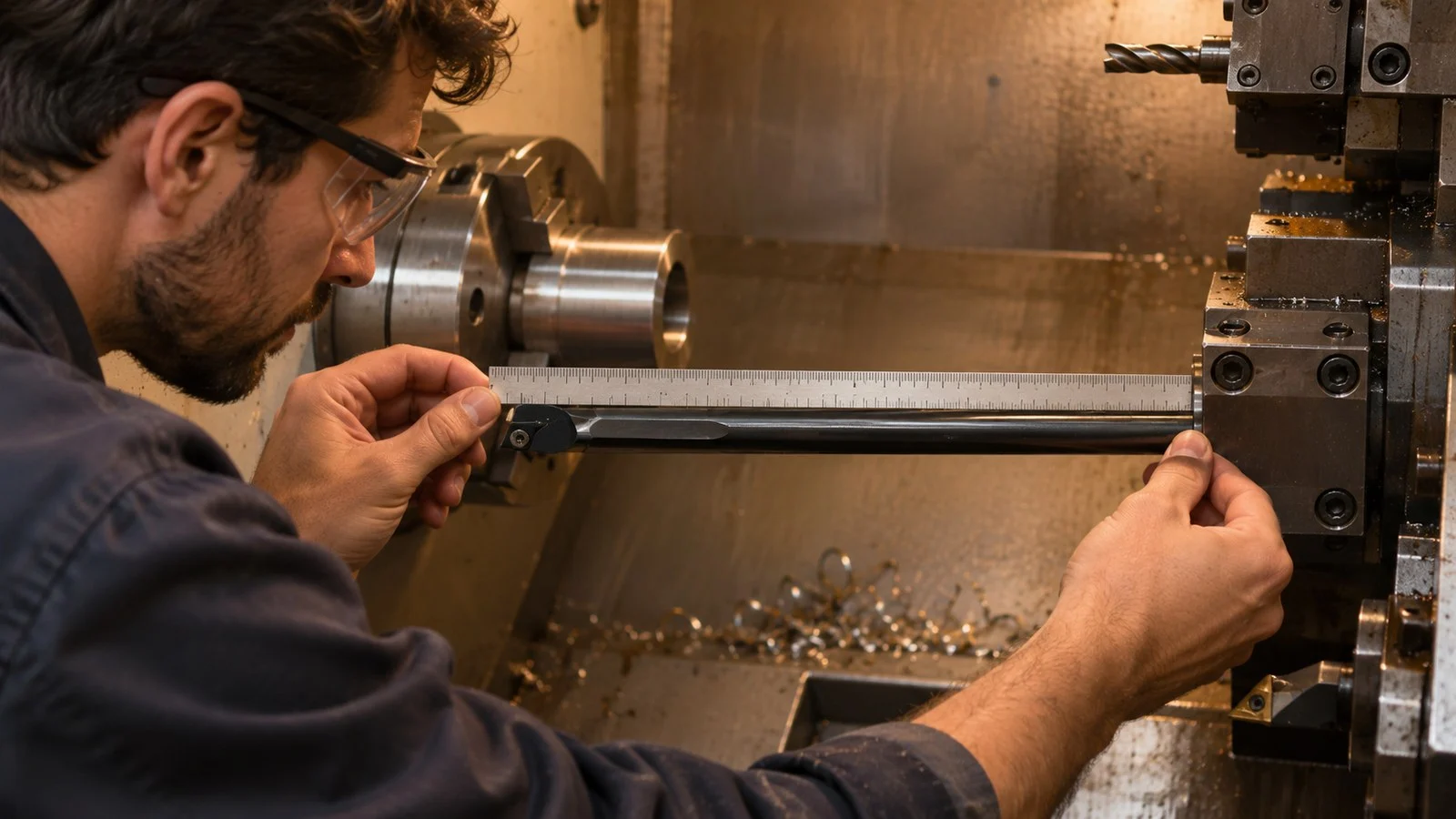
A practical starting point for the boring bar overhang ratio is 4:1 for a steel bar and 6:1 for a carbide bar in Sandvik Coromant’s internal turning guidance. Carbide offers greater static stiffness, but the permitted reach depends on the specific bar and operation; damped bars have separate recommendations.
How to Calculate Boring Bar Overhang Ratio
The boring bar overhang ratio is the unsupported length extending from the holder divided by the bar diameter. Measure from the holder’s front face to the cutting end, then divide by the bar diameter using the same units. A smaller ratio generally gives a more stable starting point for internal turning.
For example, a 20 mm diameter bar extending 80 mm from its holder has an overhang ratio of 4:1. The length inside the holder isn’t part of that measurement.
Increasing the unsupported length makes the bar more flexible and can increase vibration. If you can move the holder closer to the cutting edge, you can reduce the ratio without changing the bar.
Steel, Carbide, and Damped Bar Ratios
The Sandvik Coromant turning table gives these maximum recommended overhangs for its bar types. BD means bar diameter.
| Bar type | Turning | Grooving | Threading |
|---|---|---|---|
| Steel | 4 × BD | 3 × BD | 3 × BD |
| Carbide | 6 × BD | 5 × BD | 5 × BD |
| Steel damped | 10 × BD | 5 × BD | 5 × BD* |
| Carbide-reinforced damped | 14 × BD | 7 × BD | 7 × BD |
\*The threading figure for steel damped bars is identified for 570-4C bars.
These figures help show why the operation and bar construction matter. They aren’t ratings for every bar of the same material or for our products. Carbide provides more static stiffness than steel, while a damped bar has a different construction and its own reach guidance.
Jones Marketing lists up to 8:1 in its separate carbide-bar selection guidance. That figure and Sandvik’s 6 × BD turning recommendation belong to their respective guidance; neither is a universal carbide-bar limit. Check the exact bar model and supplier’s conditions before choosing a reach.
Choose the Largest Bar That Fits
A larger bar diameter reduces the overhang ratio for the same reach and can improve stability. Choose the largest bar that fits while leaving enough clearance between the bar and bore wall for chip evacuation and radial deflection.
For example, at an 80 mm overhang, a 20 mm bar gives 4:1; a 16 mm bar gives 5:1. The larger bar is the better starting point only if it fits the bore with the necessary clearance. You can review our machining category when selecting a turning system.
Check Clamping and Cutting Edge Height
Overhang and clamping length are separate measurements. The overhang is outside the holder; the clamping length is the portion held inside it. Sandvik recommends a clamping length of 4 × BD in its boring-bar guidance and, where possible, 6 × BD for bars longer than 200 mm. Follow the instructions for your own bar and holder.
Cutting edge height also needs to match the tool system. Sandvik specifies mounting its cylindrical CoroTurn SL bars on the centre line, even though the bar may deflect slightly below centre during cutting. Don’t transfer that setting automatically to a different holder design.
Check Reach Before Selecting a Bar
Before settling on a bar, measure the required unsupported reach, identify the operation, and check the bar material and model against its supplier’s guidance. Then confirm bore clearance and clamping length. Our boring bar overhang ratio category can help you find the relevant turning systems for further specification checks.
A reach calculation also doesn’t establish clearance at the bottom of a blind hole. Check the cutting end and its movement separately when the operation approaches a closed bore end.
FAQ
What Overhang Is Recommended for Steel Bars?
Sandvik’s table recommends a maximum of 4 × bar diameter for steel bars in turning, and 3 × diameter for grooving and threading. Check the specific bar and holder guidance before applying those figures.
What Is a Typical Boring Bar Ratio?
Sandvik’s turning guidance lists 4:1 for steel and 6:1 for carbide bars. Damped bars have different recommendations, and other suppliers may give different figures for their products.
Should a Boring Bar Be Above Centre?
For cylindrical CoroTurn SL bars, Sandvik specifies mounting on the centre line, although the bar may deflect slightly below it during cutting. Use the setting specified for your own tool system.
Does Clamped Length Count as Overhang?
No. Overhang is the unsupported length extending from the holder; clamped length is the portion held inside it. Measure each separately when checking the setup.