

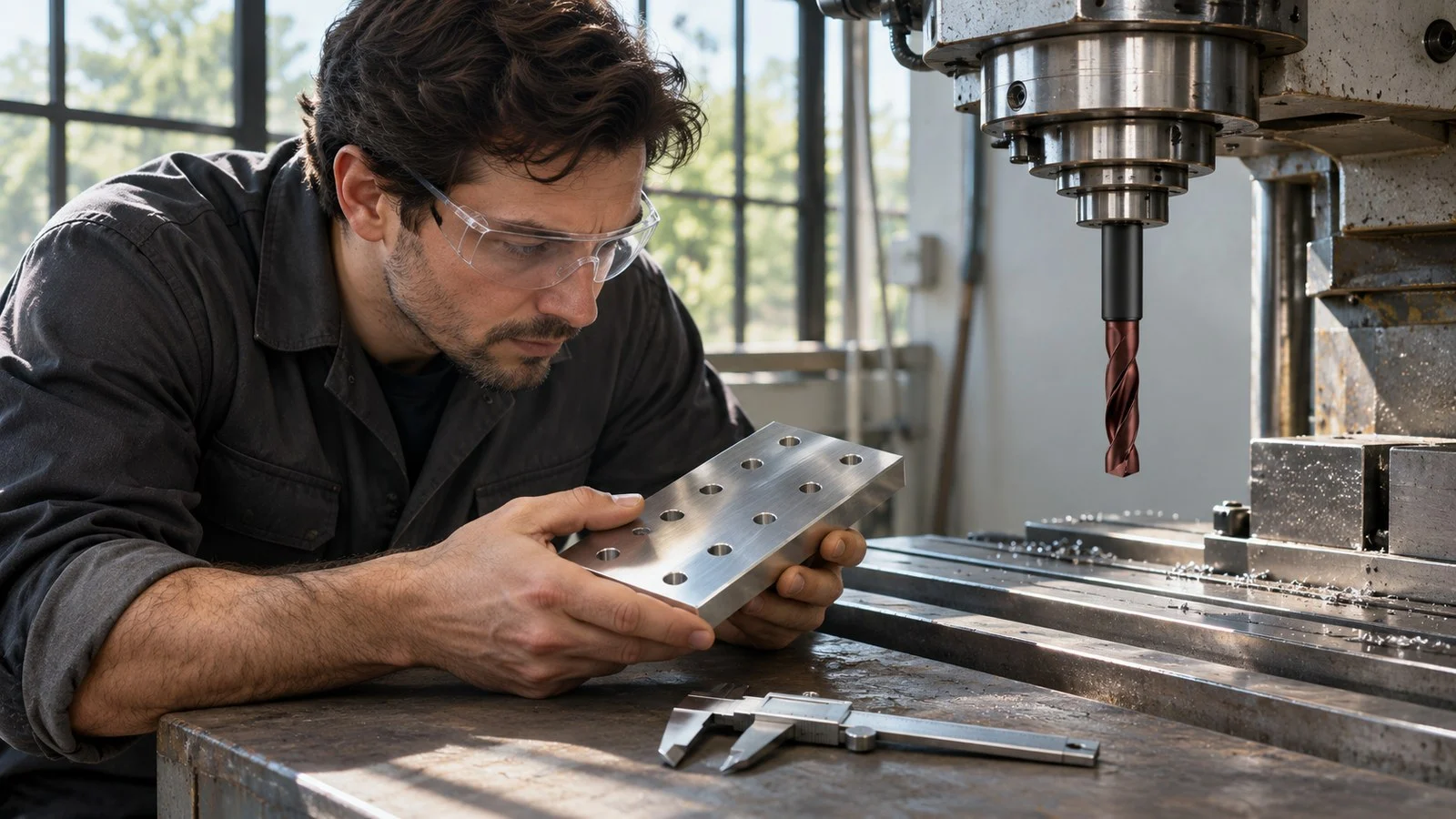
Common drill hole oversize causes include a drill that runs off-center, worn or uneven cutting edges, and movement or deflection during cutting. Start by checking the drill and its holder; if they’re sound, inspect the workpiece support and the drill geometry for the job.
What Causes an Oversize Drilled Hole?
An oversize drilled hole can result from runout, damaged cutting edges, an unstable workpiece, or a drill that deflects under cutting forces. Unequal cutting lips and a worn drill bushing are additional checks for carbide-tipped drills. Each is a possible cause, so inspect the setup before changing the tool or cutting conditions.
The measured diameter is the issue here. A hole can also be out of position, angled, or have an exit burr, but those are separate conditions. Check for them individually even when more than one appears on the same part.
Check the Drill and Holder
Start with the cutting edges. A worn or damaged drill may cut unevenly and produce an oversize or irregular hole. Look for chipped corners, uneven edges, wear on the margins, and damage to the shank. Replace or have the drill serviced if its condition warrants it, then check the resulting hole.
Next, check how the drill runs in the holder. Dirt or damage in a chuck, incorrect seating, or spindle wear can contribute to radial runout. Make sure the drill is seated correctly and the holder is secure; if the drill still doesn’t run true, investigate the holder and spindle before attributing the problem to the cutting edges.
For a carbide-tipped drill, inspect the point geometry as well. Unequal lip heights and excessive lip relief are possible causes of oversize holes. A worn drill bushing is another check where a bushing is used. Have point geometry corrected to suit the drill, and replace a worn bushing.
Check Workpiece Support and Drill Deflection
A workpiece that moves during drilling can let the drill wander. Check the clamping and support, especially on thin stock or small components. Supporting thin material underneath can help reduce vibration and deformation.
Long drills and small-diameter drills are more prone to deflection under cutting forces. If the drill is flexible for the job, consider a more rigid setup and geometry suited to the application. Deflection can also leave a hole angled, so check both diameter and direction instead of treating them as the same fault.
When reviewing a setup for machining, compare the drill with the required hole and the workpiece support. A change that improves support may be more useful than replacing a sound drill.
Match Troubleshooting to the Drill Type
With an exchangeable-tip drill, check tip wear, runout, workpiece stability and toolholding when a hole is out of tolerance. These checks can help investigate an oversize reading, but an out-of-tolerance hole can have other dimensional problems too.
For an indexable-insert drill, the checks differ between a rotating drill and a non-rotating drill on a lathe. Alignment is a relevant check for the non-rotating setup; coolant flow and blocked coolant passages are among the checks for a rotating setup. Follow the tool maker’s guidance for the drill and arrangement you’re using.
If you’re comparing tools while investigating drill hole oversize causes, check the exact tool model and material before selecting a replacement. Our catalog also lists 3D drill bits; confirm the specifications for the model you need.
Check the Hole After Each Change
Change one suspect condition at a time where practical, then check the next hole’s diameter. That makes it easier to tell whether cleaning the holder, replacing a worn drill, improving support, or correcting another condition addressed the oversize.
If the diameter is acceptable but the hole remains off location or has an exit burr, investigate that remaining fault separately.
FAQ
Can Drill Runout Cause Oversize Holes?
Yes. Radial runout can make a drilled hole larger than the drill’s nominal diameter. Check drill seating and holder condition, then investigate the spindle if the drill still doesn’t run true.
Can a Worn Drill Produce Oversize Holes?
It can. Worn margins, damaged edges, and chipped corners are useful inspection points when the drill cuts an oversize or irregular hole.
Is Hole Wander the Same as Oversize?
No. Wander concerns where the hole goes; oversize concerns its diameter. They can occur together, so check both conditions separately.