

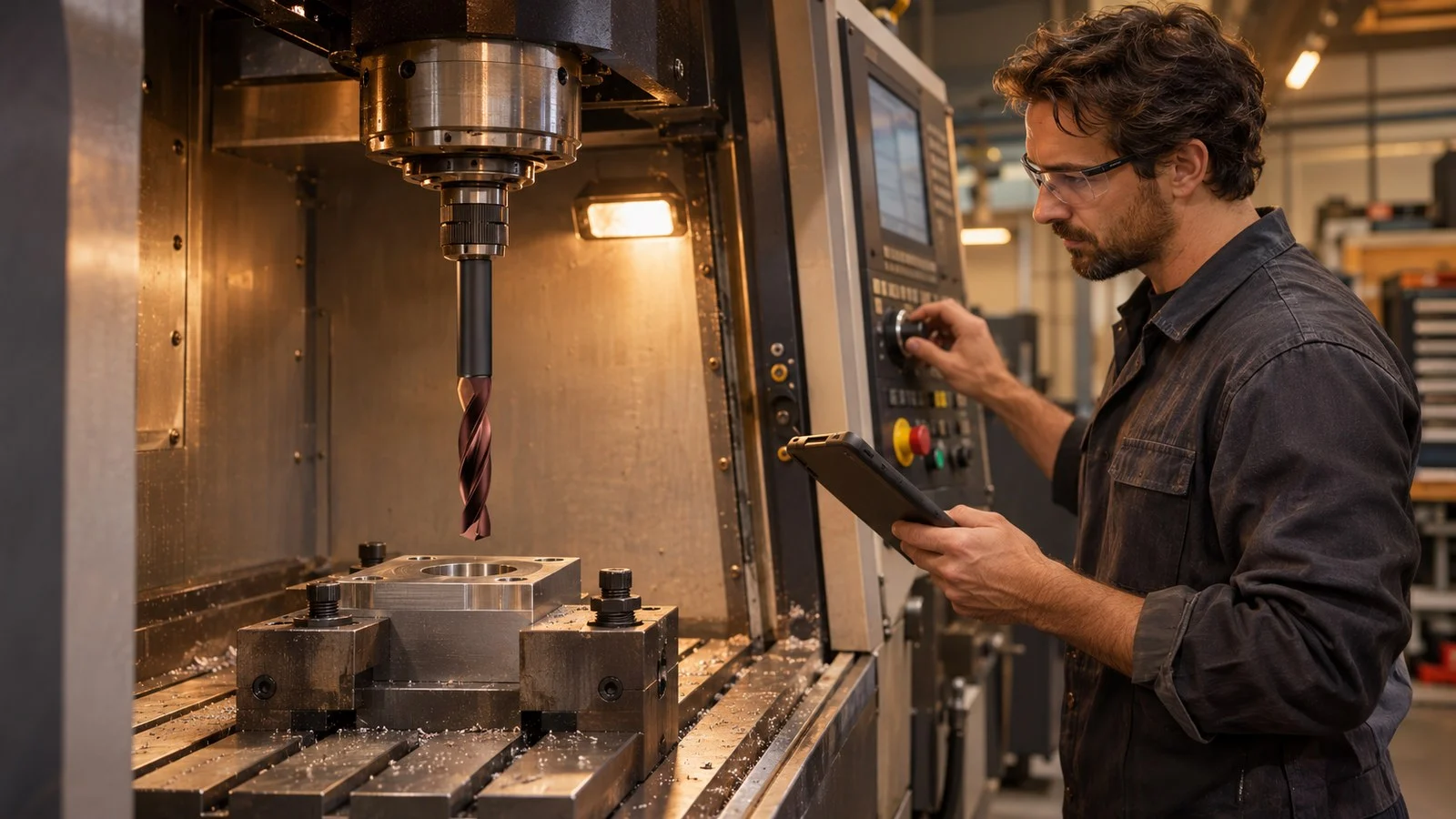
Drill cutting speed calculation converts a chosen surface speed and drill diameter into spindle RPM. To calculate axial feed, multiply the actual spindle RPM by the chosen feed per revolution; if the machine limits RPM, use the limited speed in the feed calculation.
Drill Cutting Speed and RPM Formulas
Drill cutting speed is the speed at the drill’s outside diameter, expressed in meters per minute or surface feet per minute. Spindle RPM is the number of drill revolutions per minute. For a given cutting speed, a larger drill diameter requires a lower RPM than a smaller diameter.
Use the formula that matches your units:
| Units | Spindle Speed Formula | Inputs |
|---|---|---|
| Metric | n = 1000 × Vc / (π × D) | Vc in m/min; D in mm |
| Imperial | n = 12 × SFM / (π × D) | SFM in ft/min; D in inches |
| Imperial, rounded | n ≈ 3.82 × SFM / D | SFM in ft/min; D in inches |
Here, n is spindle speed in revolutions per minute, Vc is cutting speed, and D is drill diameter. The 3.82 factor is rounded, so the approximate imperial formula can differ slightly from the formula using π.
These formulas calculate RPM from a cutting speed; they don’t select the cutting speed for your drill or workpiece.
Calculate Drill Feed Rate
Drilling feed per revolution describes how far the drill advances axially during one spindle revolution. Multiply it by actual RPM to get the axial feed rate:
Metric: Feed rate (mm/min) = actual RPM × feed per revolution (mm/rev)
Imperial: Feed rate (in/min) = actual RPM × feed per revolution (in/rev)
Use feed per revolution directly in this calculation. Don’t multiply it by flute count. End-mill chip-load calculations, such as those for topic #42, use feed per tooth; hob speeds and feeds, as in topic #66, address a different cutting operation.
Metric Drill Speed and Feed Example
Suppose a 10 mm drill has a hypothetical cutting speed of 100 m/min:
n = 1000 × 100 / (π × 10) = 3,183 RPM
If the spindle is limited to 2,500 RPM, the drill runs at a lower actual cutting speed:
Vc = π × 10 × 2,500 / 1000 = 78.54 m/min
With a hypothetical feed of 0.10 mm/rev, calculate axial feed from the actual spindle speed:
Feed rate = 2,500 × 0.10 = 250 mm/min
The cutting speed and feed in this example are hypothetical arithmetic inputs, not recommended machining parameters. A spindle cap changes the actual surface speed, so check both the resulting speed and the feed per revolution against the conditions for the exact drill.
Imperial Drill RPM Example
For a hypothetical 0.5-inch drill and a cutting speed of 100 SFM:
n = 12 × 100 / (π × 0.5) ≈ 764 RPM
Using the rounded 3.82 factor gives the same result to the nearest RPM:
n ≈ 3.82 × 100 / 0.5 = 764 RPM
The 100 SFM input is hypothetical. For a feed rate in inches per minute, multiply the actual RPM by the selected feed in inches per revolution.
Check Drill and Machine Conditions
Before entering a program, confirm the drill diameter, machine spindle limit and units used for both speed and feed. Consult the exact drill and machine manufacturers for operating conditions, including the required chip load. A calculated RPM or feed rate alone doesn’t establish that the setup is suitable.
If you’re selecting a drill, our 3D drill bits page is a starting point for identifying the product; use the operating data for the exact drill before setting machining parameters. Stop and secure the machinery before inspecting the drill or workpiece manually.
FAQ
How Do You Calculate Drill RPM?
For metric units, divide 1,000 times cutting speed in m/min by π times drill diameter in mm. For imperial units, divide 12 times SFM by π times drill diameter in inches.
How Do You Calculate Drilling Feed Rate?
Multiply actual spindle RPM by feed per revolution. The result is in mm/min when feed is in mm/rev, or in/min when feed is in in/rev.
What If the Spindle Can’t Reach RPM?
Use the machine’s actual RPM to calculate the resulting cutting speed and axial feed. Check those conditions, including required chip load, with the exact drill and machine manufacturers.