

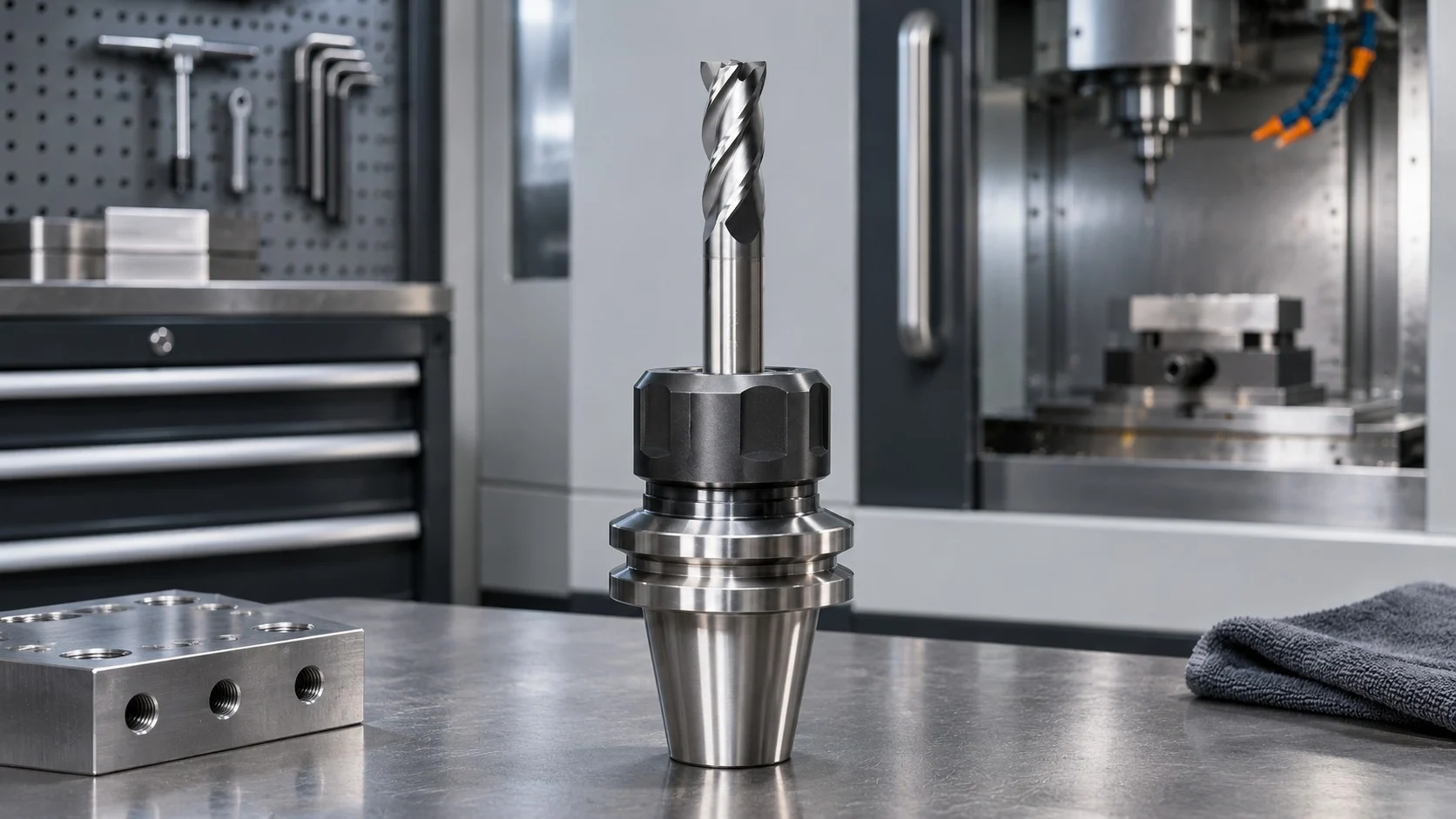
End mill stickout length is the distance from the holder or collet end to the tool tip. Use the shortest stickout that clears the workpiece and reaches the feature; longer overhang reduces rigidity and can increase deflection, so extend the tool only as far as the geometry requires.
End Mill Stickout Is Different From Cutting Length
Stickout measures how far the tool extends beyond the holder or collet. It is not the same as flute cutting length, the tool’s overall length, or holder gauge length. Those dimensions describe different parts of the tool and setup.
Flute cutting length is the portion of the cutter designed to cut along its axis. Overall length runs from the tool tip to the opposite end of the tool. Holder gauge length measures from the spindle gauge line to the holder’s end. Keep these dimensions separate when checking whether a tool can reach a feature.
Choose Stickout for Reach and Clearance
End mill stickout length should be just long enough to reach the deepest feature while clearing the surrounding material. Compare the needed reach with the pocket depth, pocket diameter, tool geometry, and the clearance available between the holder and the workpiece. Check the full holder as well as the cutting end: a cutter may reach the bottom while the holder collides with the pocket wall.
Make manual measurements and clearance checks only with the machine stopped and secured. If the tool needs more reach, confirm that enough shank can remain inserted and clamped according to the tool and holder manufacturers’ instructions. Do not clamp on the flutes; use the tool’s specified shank and follow the holder’s clamping requirements.
Longer Stickout Can Increase Deflection
A longer unsupported section makes the setup less rigid and can increase tool deflection under cutting forces. Deflection may affect the cut and may call for lighter chip loads, but there is no single overhang limit or correction that applies to every tool and operation.
Use the shortest stickout that clears the workpiece, then consider the tool diameter, cutting engagement, material, and setup rigidity together. Avoid relying on a universal diameter-based rule or a fixed feed adjustment. For example, Sandvik’s guidance on shallow radial cuts and larger tool core diameter applies to its heat-resistant superalloy machining context; it is not a setting for every end mill or material.
Match Tool Geometry to the Feature
Long-reach and long-flute tools solve different access problems. Some long-reach designs reduce the neck behind the cutting edge so the tool can enter a gap that the shank cannot fit through. Long-flute tools provide more cutting length and may suit finishing a wall or a slot. Choose geometry by checking both the feature and the surrounding clearance; extra cutting length does not automatically provide extra clearance for the holder.
For a shallower feature, a shorter tool extension may provide a more rigid setup. When selecting a cutter for the material and operation, our Flat Endmill HRC50 is one product option to review; confirm its listed dimensions and compatibility with your setup before choosing it.
FAQ
How Is Stickout Measured?
Measure from the holder or collet end to the tool tip. Do not substitute flute length, overall length, or holder gauge length.
Should Stickout Be Minimized?
Use the shortest stickout that reaches the feature and clears the workpiece. Confirm holder clearance and the manufacturer’s shank-grip requirements.
Can a Longer Flute Increase Reach?
A longer flute increases cutting length, but it does not necessarily solve holder clearance or provide the best reach for a narrow gap. Check the tool and holder geometry against the feature.