

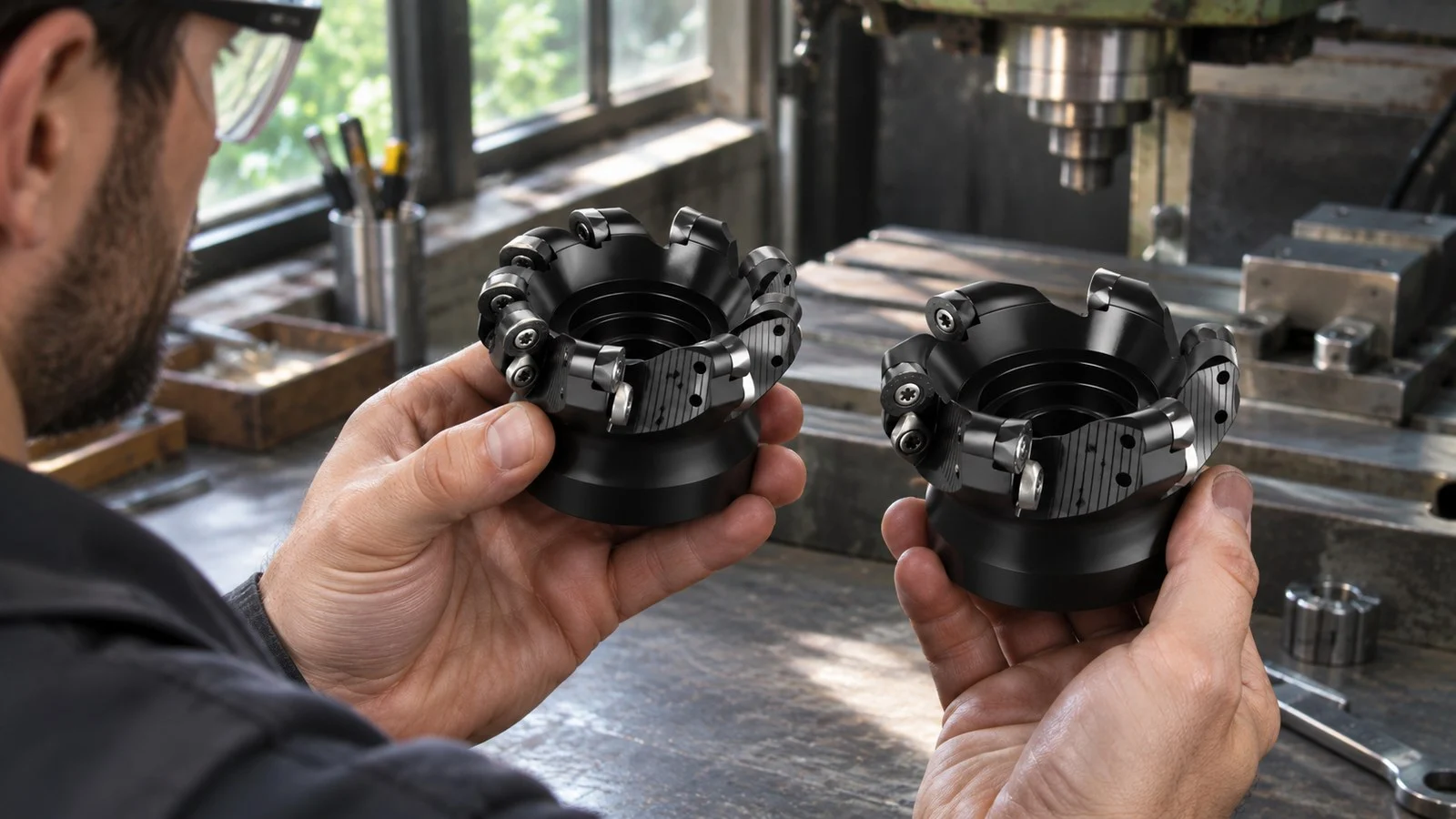
Choose a coarse face milling insert pitch when the cut produces bulky chips or the setup needs a lighter load. Choose a fine pitch when chip size is small and the machine and workholding are rigid enough to support more cutting edges in the cut.
Coarse vs Fine Face Milling Insert Pitch
A coarse-pitch face mill has fewer insert positions around a given cutter diameter and more space for chips between them. A fine-pitch cutter has more insert positions and smaller chip pockets. Fine pitch can support a higher table feed at the same feed per tooth, provided the machine and setup can handle the load.
| Selection factor | Coarse pitch | Fine pitch |
|---|---|---|
| Insert positions at the same diameter | Fewer | More |
| Chip pocket space | More space per pocket | Less space per pocket |
| Edges engaged in the same cut | Generally fewer | Generally more |
| Machine load | Often preferable when capacity is limited | Requires attention to load as more edges engage |
| Radial engagement | Useful for wide cuts with long edge engagement | Useful for shallow or narrow cuts that produce smaller chips |
| Potential table feed | Fewer edges limit feed at the same feed per tooth | More edges can allow higher feed at the same feed per tooth |
Compare cutters at the same diameter, depth of cut, feed per tooth and radial engagement. A fine-pitch cutter doesn’t automatically run faster: the usable feed also depends on the cutter, machine capacity and rigidity of the complete setup.
Coarse Pitch: Strengths and Best Uses
A coarse-pitch face mill has relatively few insert positions for its diameter. Its larger chip pockets make it a useful choice when chips are long or bulky, or when a wide cut keeps each edge engaged for longer. It can also be a practical starting point for a lighter-duty machine or a less rigid setup.
The tradeoff is that fewer edges can be engaged over the same portion of the cut. At the same feed per tooth, that limits the potential table feed compared with a fine-pitch cutter. Coarse pitch is a strong choice when chip clearance and manageable loading take priority over adding more edges.
Fine Pitch: Strengths and Best Uses
A fine-pitch face mill has more insert positions for its diameter. With more edges available, it can support a higher table feed at the same feed per tooth when the machine and setup are sufficiently rigid. It suits cuts that produce smaller chips, such as shallow or narrow cuts.
The smaller chip pockets leave less room for chip evacuation. If chips pack into a pocket, they can damage a cutting edge and potentially the workpiece. Fine pitch is therefore less attractive when the cut produces long chips or when a wide engagement requires more chip space.
Choosing a Face Milling Pitch
Choose coarse pitch if:
- The cut produces long or bulky chips.
- A wide cut keeps the inserts engaged for a longer portion of each revolution.
- Machine capacity or setup rigidity makes a lighter load desirable.
Choose fine pitch if:
- The cut produces small chips that can clear the available pockets.
- The machine, holder and workholding provide a rigid setup.
- You want to increase potential table feed while maintaining an appropriate feed per tooth.
Before selecting a cutter, check the intended radial engagement and chip size against the cutter’s available pocket space. Our BRP Face Milling Cutter Head is one product to review; confirm its available pitch and compatibility before choosing. Follow the machine and cutter manufacturers’ instructions for the setup and cutting parameters.
FAQ
Does Fine Pitch Always Cut Faster?
No. More inserts can allow a higher table feed at the same feed per tooth, but only if chip clearance, machine capacity and setup rigidity support it.
Is Unequal Pitch the Same as Coarse Pitch?
No. Coarse and fine describe the relative number of insert positions for a cutter diameter. Unequal pitch describes spacing between positions, so it doesn’t by itself tell you whether a cutter is coarse or fine.
Does Material Alone Determine Insert Pitch?
No. Chip size and shape matter, but so do the width of cut, machine capacity and rigidity. A material doesn’t automatically require one pitch for every face milling operation.