

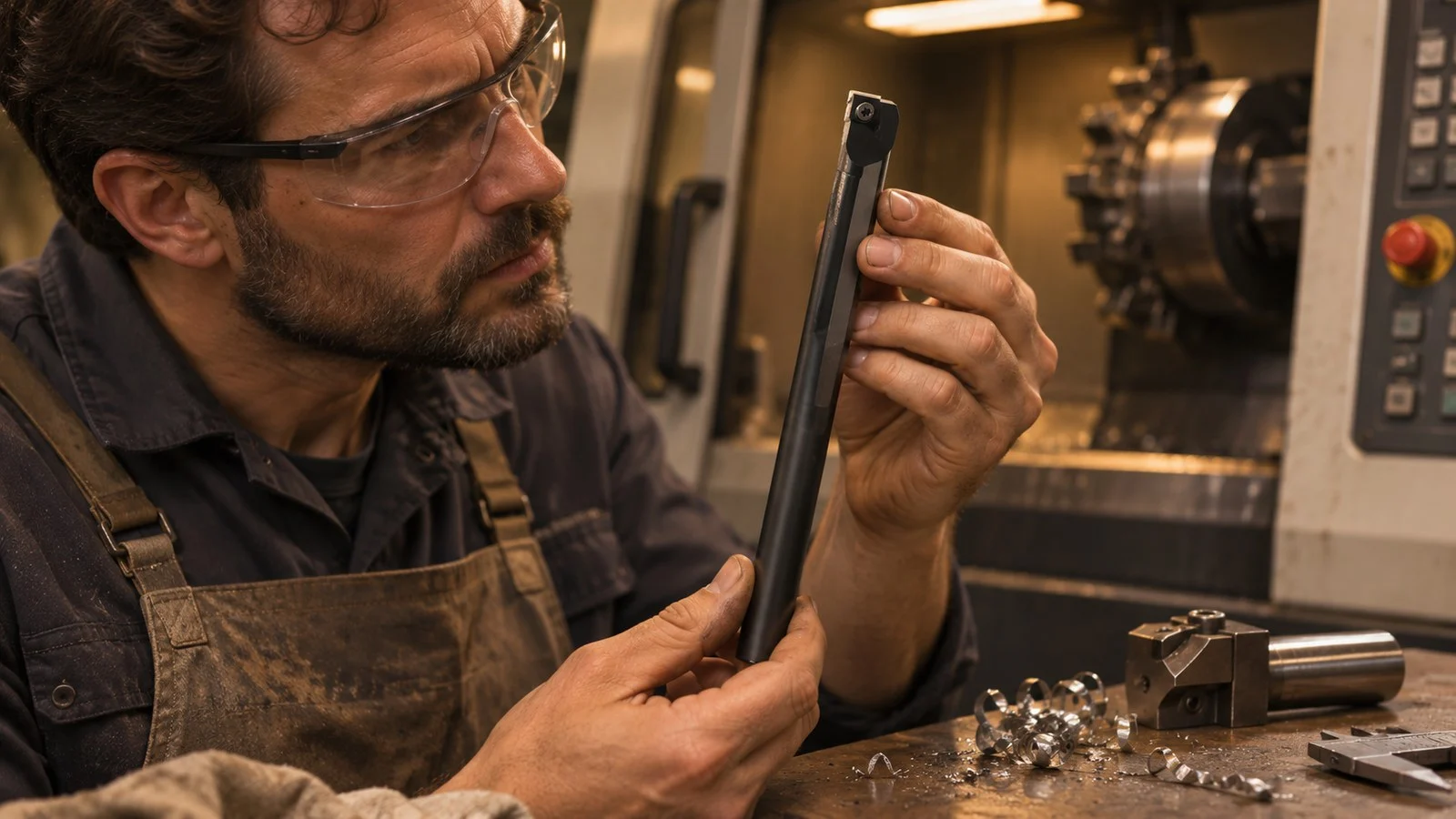
Flank wear in a cutting tool appears as a worn band along the cutting edge, on the face next to the machined surface. Some gradual wear is normal; the practical concern is wear that develops quickly or coincides with a loss of surface finish or dimensional accuracy.
What Is Flank Wear?
Flank wear is the gradual wearing of the tool face that faces the machined surface. It often appears as a fairly even band along the cutting edge. The band develops during machining, so its presence alone doesn’t tell you whether the tool has reached the end of its useful life.
The flank face is different from the rake face, where the chip travels. When you inspect an edge, identify which face you’re looking at before deciding what kind of wear you see.
How to Recognize Flank Wear
Look for a band on the flank face and compare its appearance along the working portion of the edge. A relatively even band is consistent with gradual flank abrasion. Clean the edge before judging its extent: workpiece metal smeared over the edge can make the worn area look larger than it is.
A visual check is more useful when you compare the same part of the edge at successive inspections. A growing band tells you more than a single observation, especially when you can compare it with changes in the machined part.
Flank Wear vs Crater Wear and Chipping
The location and shape of the damage help you describe what you’re seeing, but appearance alone doesn’t identify a single cause.
- Flank wear: A band on the flank face, often relatively even along the working edge.
- Crater wear: A depression or pits on the rake face.
- Chipping: Local pieces missing from the cutting edge, giving it an irregular appearance.
More than one form of damage can be present on the same tool. Check both faces and the edge itself before deciding which pattern needs attention.
What Causes Flank Wear?
Abrasion contributes to gradual flank wear. Cutting conditions and tool selection can affect how wear develops, but a worn band by itself doesn’t reveal which condition is responsible.
Cutting speed is one factor to investigate when flank wear develops faster than expected. Tool grade, feed and coolant are also candidates for a contextual check. Consider them alongside the workpiece material, operation and other cutting conditions rather than changing several settings at once.
The operation matters. For example, rapid flank wear in milling heat-resistant superalloys can affect surface finish or leave dimensions outside tolerance. That doesn’t mean every worn flank will cause the same result in every material or operation.
Flank Wear Diagnostic Checks
Start with the tool and the part, then review the cutting conditions if wear is progressing too quickly.
- Inspect the edge. Clean away smeared material and check the flank, rake face and cutting edge for distinct wear patterns.
- Compare inspections. Check whether the flank band is growing gradually or has changed quickly since the previous inspection.
- Check the part. Compare surface finish and dimensions with the job requirements.
- Review the setup. Check cutting speed, tool grade, feed and coolant in the context of the material and operation.
For a boring setup, the S16Q-SCLCR09 page is a starting point for identifying the holder. Assess the actual cutting edge used in the job separately; the holder model alone doesn’t establish the insert or coating.
If a condition needs adjustment, record the current setting and change one candidate at a time where the process allows. Inspect the edge and the next parts again so you can compare the result.
FAQ
Is Flank Wear Always a Problem?
No. Flank abrasion can develop normally over machining time. Check its progression against the surface finish and dimensional requirements of the job.
Can Flank Wear Affect Surface Finish?
Yes. In milling heat-resistant superalloys, rapid flank wear can lead to poor surface finish or dimensions outside tolerance.
Is Crater Wear the Same as Flank Wear?
No. Crater wear appears as a depression or pits on the rake face, while flank wear appears on the flank face.