

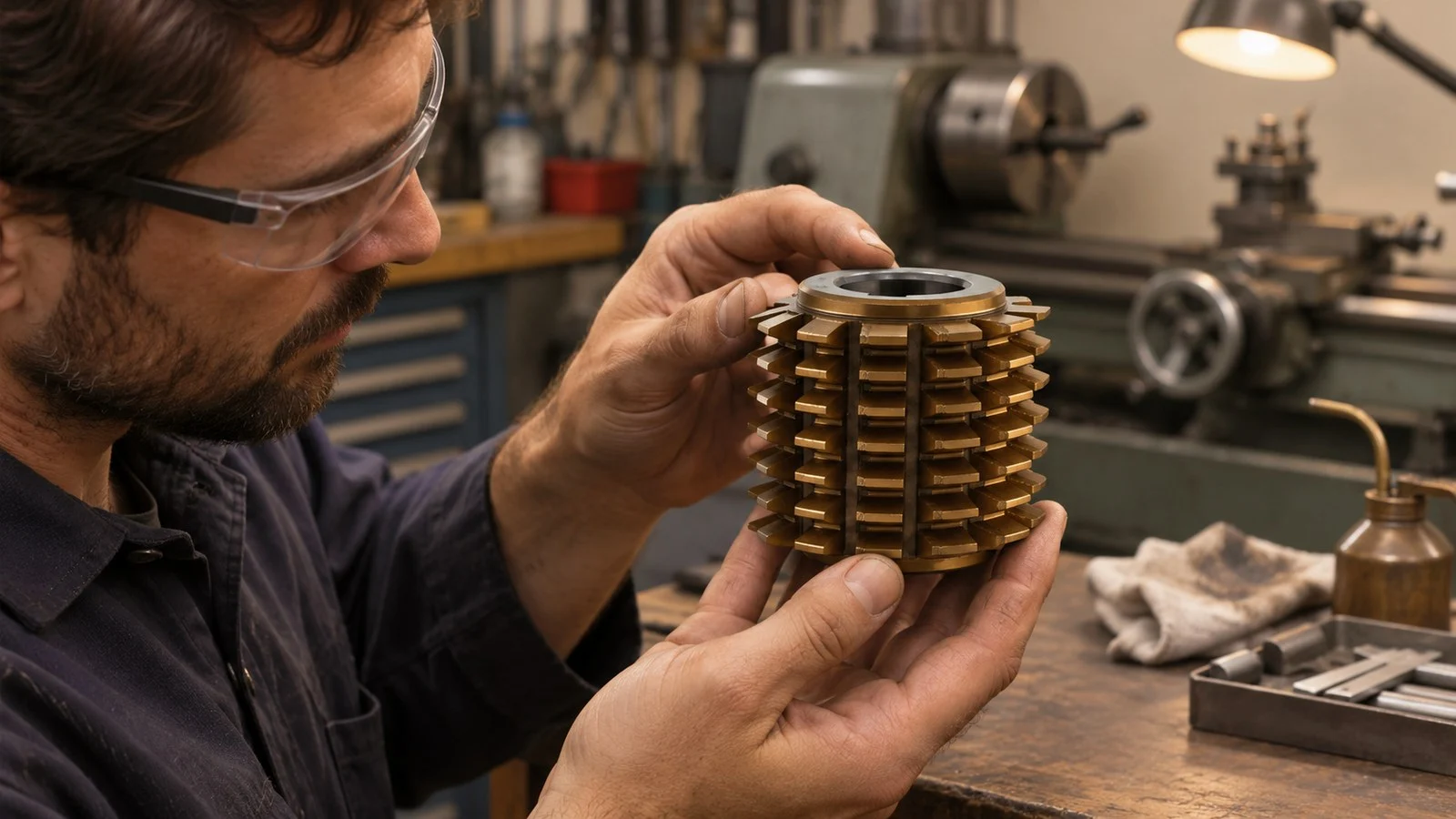
For a roller-chain sprocket, choose a sprocket hob matched to the chain and sprocket tooth form. For a common involute spur or helical gear, choose a gear hob matched to the gear’s involute geometry. In a sprocket hob vs gear hob comparison, the deciding factor is the form you need to produce.
Sprocket Hob vs Gear Hob: Key Differences
A roller-chain sprocket hob is selected for a sprocket tooth form that matches the specified chain. An involute gear hob is selected for the geometry of an involute gear. Both are hobs, but their intended tooth forms and ordering information differ, so matching pitch alone isn’t enough to select either tool.
| Selection Point | Roller-Chain Sprocket Hob | Involute Gear Hob |
|---|---|---|
| Intended tooth form | Sprocket form for the specified roller chain | Involute form for the specified gear |
| Main pitch information | Chain pitch | Module or diametral pitch |
| Other geometry | Roller diameter and sprocket tooth form | Pressure angle and gear tooth geometry |
| Drawing review | Chain and sprocket drawing | Gear drawing and relevant tool data |
| Equipment fit | Arbor and machine compatibility | Relevant tool and machine requirements |
Sprocket Hob: Use and Selection
A sprocket hob is a hob intended to produce a specified sprocket tooth form. For a roller-chain application, its strength is that the form can be matched to the chain and sprocket requirements. It suits work where the chain standard, pitch and roller diameter are known.
The drawback is that a hob selected for one chain or tooth form shouldn’t be assumed suitable for another. Chain standards can have different dimensions, so give the tool supplier the standard and the chain and sprocket drawing. When reviewing our Sprocket Wheel Hobbing Cutter, check the required tooth form and machine fit against the tool details before ordering.
Gear Hob: Use and Selection
An involute gear hob is intended for an involute gear tooth form. It suits common involute spur and helical gear work when the module or diametral pitch, pressure angle and relevant geometry are defined.
The drawback is that matching a pitch designation alone doesn’t establish that the hob will produce the required gear. Review the gear drawing and relevant tool data as well. Gear hobs also include forms other than involute, so identify the specified tooth form before selecting a hob.
Which Hob Should You Choose?
Choose a sprocket hob if:
- You need a roller-chain sprocket tooth form.
- You can identify the chain standard, pitch and roller diameter.
- You have the chain and sprocket drawing and can check arbor and machine compatibility.
Choose an involute gear hob if:
- Your drawing calls for an involute spur or helical gear.
- You can provide the module or diametral pitch and pressure angle.
- You can check the gear drawing against the relevant tool data.
FAQ
Is a Sprocket Hob a Gear Hob?
A sprocket hob is a type of hob used for a sprocket tooth form. The important selection detail is the specified form: a roller-chain sprocket form and an involute gear form require different geometry.
Does Matching Pitch Make Hobs Interchangeable?
No. Pitch alone doesn’t define the complete tooth form. Check the applicable drawing and the other geometry, including roller diameter for a roller-chain sprocket or pressure angle for an involute gear.
Are All Gear Hobs Involute?
No. Gear hobs can be made for forms other than involute. Check the tooth form on the drawing before selecting a hob.