

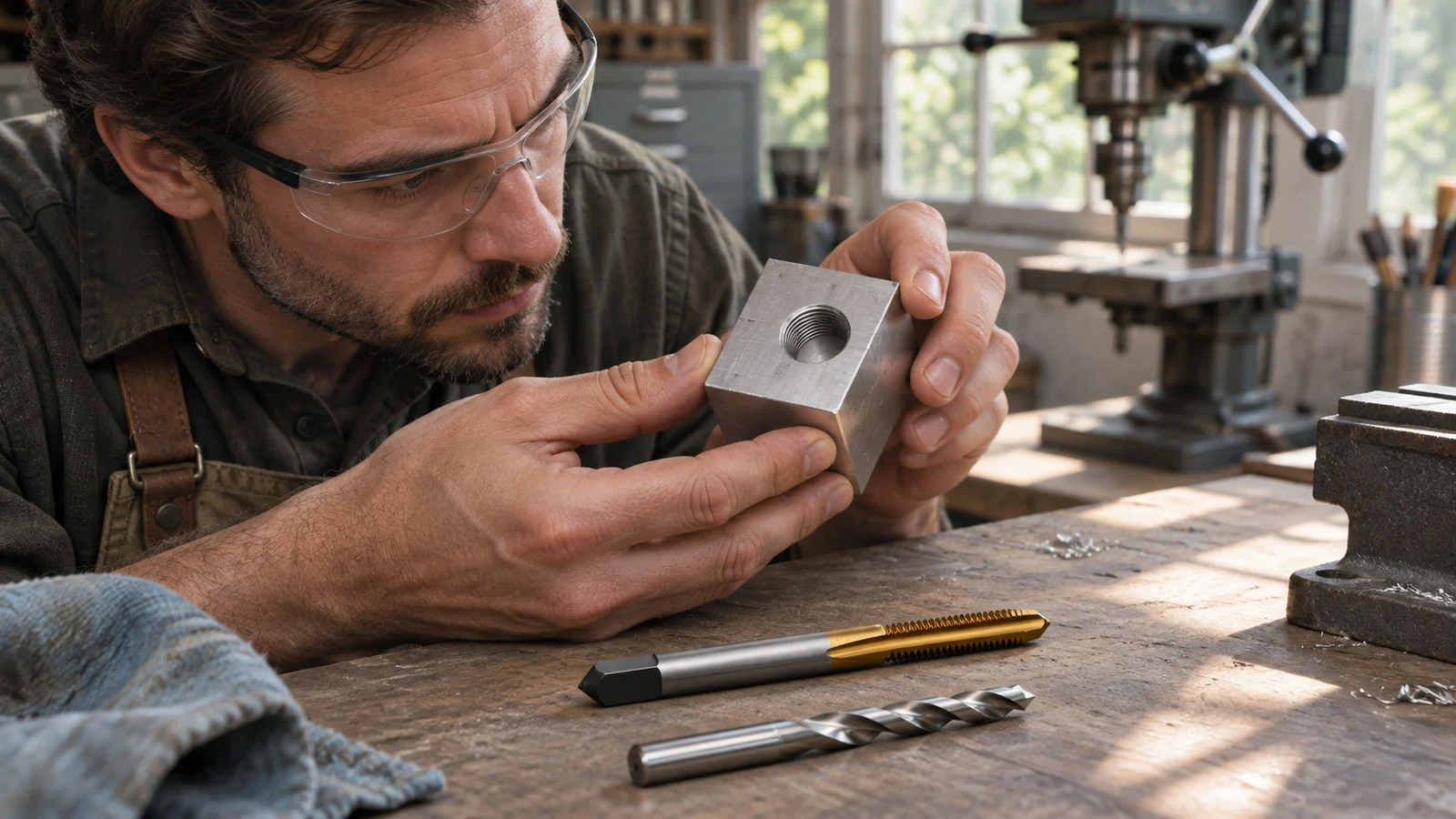
When tapping blind holes, plan the drilled depth around the fully formed thread depth on the drawing, the tap’s chamfer and travel, and the clearance needed at the bottom. A deeper drilled hole gives the tap more room, but the available depth may be limited by the part, so follow the drawing and the tap manufacturer’s guidance.
How Deep Should a Blind Tapped Hole Be?
A blind tapped hole must be deep enough for the required full thread, the tap’s incomplete lead threads, and the specified bottom clearance. The drill point extends beyond the full-diameter portion of the hole. Tap geometry, chip space, machine overtravel and the part drawing all affect the depth you can use.
A tap’s chamfer gradually brings the thread to its full profile. The tap must therefore travel beyond the drawing’s required full-thread depth. The drilled hole must then provide enough room for that travel and the clearance specified for the operation.
Thread Depth, Tap Travel and Drill Depth
These depths describe different features of the same hole:
| Depth | What It Describes |
|---|---|
| Fully formed thread depth | The length of complete thread required by the drawing |
| Tap travel | How far the tap enters the hole to produce that thread |
| Full-diameter drilled depth | The depth of the cylindrical portion of the drilled hole |
| Drill-point depth | The additional depth occupied by the drill’s point geometry |
Measure each depth from the reference surface specified on the drawing. The drill point creates a tapered bottom, so the deepest point of the hole is not the depth of the full-diameter cylindrical section.
When planning the hole, check whether the drawing specifies a full-diameter drilled depth, a total drill depth, or another depth requirement. Use the actual drill geometry and the manufacturer’s instructions to relate those dimensions.
Tap Chamfer and Bottom Clearance
A shorter chamfer can help when the required thread must extend close to the bottom of a blind hole. It reduces the length over which the tap gradually forms the thread, but the tap still needs clearance; a short chamfer doesn’t mean that a full thread reaches the absolute bottom.
Choose the tap using its manufacturer’s information and the drawing requirements. Before using our M6X1 TH2 SC HSS product for a particular hole, check the applicable tap specifications and confirm that the required thread depth and available clearance are compatible.
Don’t apply one fixed margin to every blind hole. Chamfer length, drill-point geometry, required thread depth and available material beneath the hole all affect the plan.
Chip Space and Machine Overtravel
The bottom of the drilled hole must accommodate the operation as well as the tap’s intended travel. For a cutting tap, consider the space needed for chips and follow the tap manufacturer’s guidance on chip control. That space shares the available depth with the tap’s lead and bottom clearance.
Also account for any machine overtravel permitted by the setup. Check the programmed depth against the machine and tooling used for the job; don’t assume the programmed position alone defines the clearance at the bottom.
Use qualified machine setup procedures, and never work near rotating machinery.
Blind Hole Depth Checks Before Machining
Before setting the drill and tap depths, check these items against the drawing and tooling instructions:
- Identify the required fully formed thread depth and its reference surface.
- Determine the tap travel needed to produce that depth with the chosen tap.
- Check the full-diameter drilled depth and the additional drill-point depth against the available material.
- Allow for the specified bottom clearance, chip space and any permitted machine overtravel.
- Confirm the depth settings through the qualified procedure for the machine and tooling.
FAQ
Does Tap Depth Equal Thread Depth?
No. Tap travel extends beyond the required fully formed thread depth because the tap’s chamfer forms the thread progressively.
Can a Tap Reach the Hole Bottom?
A short-chamfer tap can form a thread closer to the bottom, but it still needs clearance. Don’t assume the full thread reaches the absolute bottom.
Is Total Drill Depth Full-Diameter Depth?
No. Total depth can include the tapered drill-point area below the cylindrical portion. Check which depth the drawing specifies.