

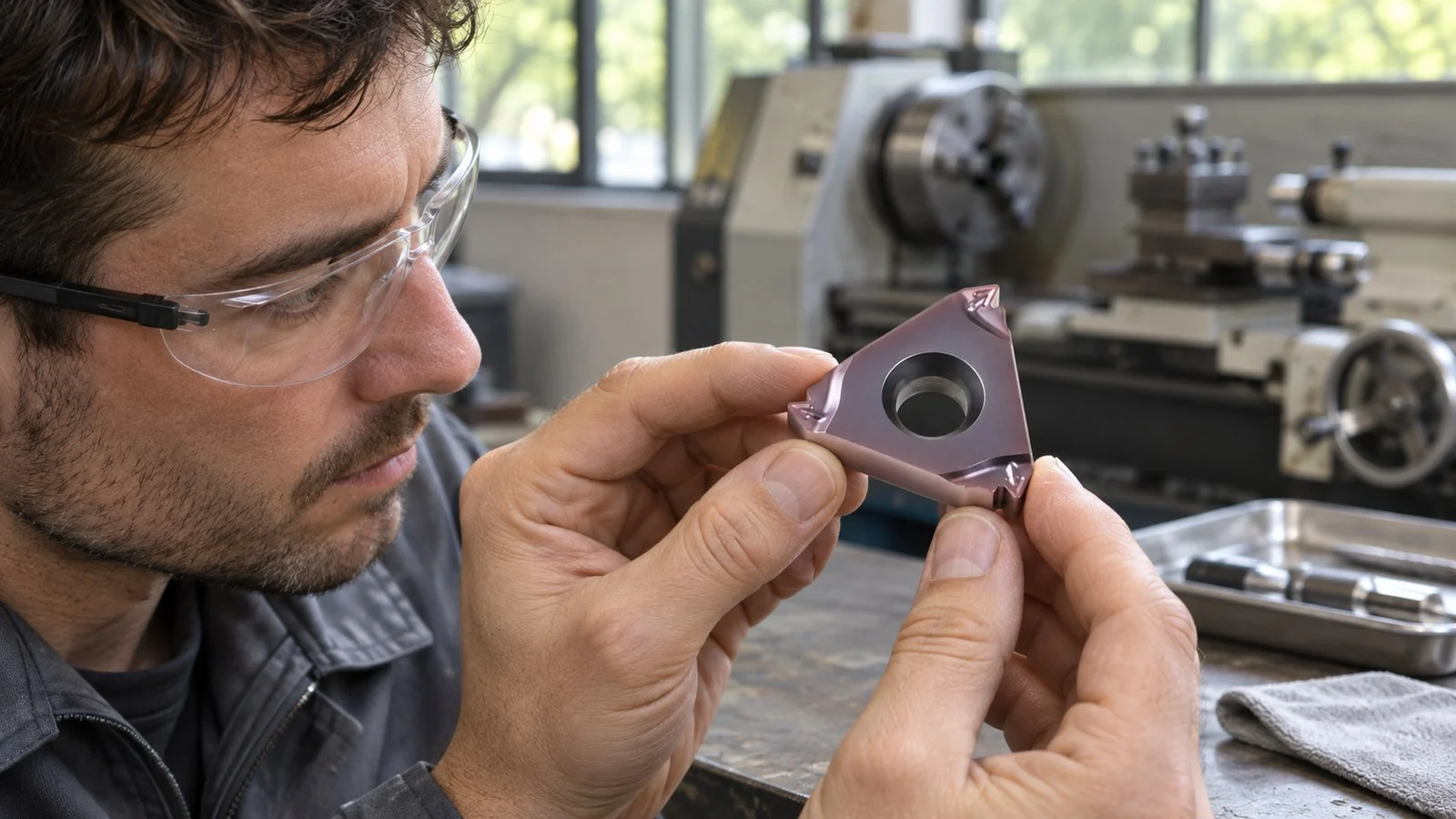
For most CNC threading jobs, modified flank infeed is a useful starting choice when the insert and machine cycle support it; radial infeed suits fine pitches and tools that require it. The choice in thread turning radial vs flank infeed affects how the insert enters the work between passes, which can change chip control, vibration and wear.
Radial vs Flank Infeed: Key Differences
Radial infeed moves the insert toward thread depth between passes, engaging both cutting flanks. Modified flank infeed offsets that movement so one flank removes most of the material while the other avoids excessive rubbing. Both methods are separate from the synchronized axial travel along the thread lead during each cutting pass.
| Consideration | Radial Infeed | Modified Flank Infeed |
|---|---|---|
| Infeed between passes | Toward thread depth, perpendicular to the turning axis | Offset toward one thread flank |
| Cutting action | Both flanks cut | Most material removal occurs on one flank |
| Chip behavior | Can produce a stiff, V-shaped chip that is difficult to control | Can improve chip control, depending on the setup |
| Wear | Can distribute wear across both flanks | Cutting load is concentrated more on one flank |
| Typical use | Fine pitches and inserts specified for radial infeed | CNC threading when the insert and cycle support it |
| Limitation | Vibration and chip control can become problems at larger pitches | Requires a suitable infeed setting and cycle |
Radial Infeed: Pros, Cons and Uses
Radial infeed advances the insert toward the thread root between passes. Both sides of the insert engage the thread form, so wear can be more even across the flanks.
The method suits fine-pitch work and is available on many conventional lathes. Its drawback is the stiff V-shaped chip formed as both flanks cut. That chip can be difficult to control, and larger pitches can increase the risk of vibration and poor chip control.
Use radial infeed when the tool instructions call for it or when it produces acceptable chips and thread quality for the job. Some multi-tooth insert families require radial infeed; check the instructions for the specific insert rather than applying that rule to every tool.
Modified Flank Infeed: Pros, Cons and Uses
Modified flank infeed shifts the insert toward one side of the thread between passes. Most material is removed by one cutting flank, while the slight offset helps prevent the other flank from rubbing against the workpiece.
This approach can improve chip control, particularly where radial infeed produces a difficult chip. The tradeoff is that cutting load and wear are less evenly distributed between the insert flanks. Results still depend on the material, insert and machine setup.
Modified flank infeed is a practical starting point for a CNC threading cycle that supports it and for an insert approved for the method. Check the machine instructions before entering an angle: controller conventions differ.
Pure Flank and Alternating Flank Infeed
Pure flank infeed follows one thread flank. Modified flank infeed changes that direction slightly to reduce rubbing on the other side. They aren’t interchangeable settings, even if a machine menu uses a shortened label.
Alternating flank infeed is another method: it changes the side taking the load between passes. It can distribute wear across both cutting edges, but it needs more complex programming and isn’t available on every lathe.
Which Infeed Should You Choose?
Choose radial infeed if:
- The insert instructions require radial infeed.
- You’re cutting a fine pitch and chip control is acceptable.
- Your machine doesn’t offer a suitable flank-infeed cycle.
Choose modified flank infeed if:
- Your insert and machine cycle allow it.
- Radial infeed produces a difficult chip or vibration.
- You can set the cycle according to the machine’s angle convention.
Before running the cycle, check the insert’s allowed infeed method and the control’s setup instructions. If you’re considering our 16ER 150ISO M90, confirm its applicable cutting data and infeed options before selecting the cycle.
FAQ
Is Flank Infeed Always Better for Threading?
No. Modified flank infeed can help with chip control, but radial infeed may suit fine pitches or be required by the insert. The machine and tool instructions determine which methods are available.
Does Radial Infeed Cut Both Thread Flanks?
Yes. Between passes, radial infeed moves the insert toward thread depth so both cutting flanks engage the workpiece.
Is Alternating Flank the Same as Modified Flank?
No. Modified flank infeed places most of the cutting load on one flank. Alternating flank infeed changes the loaded side between passes and may require a different machine cycle.