

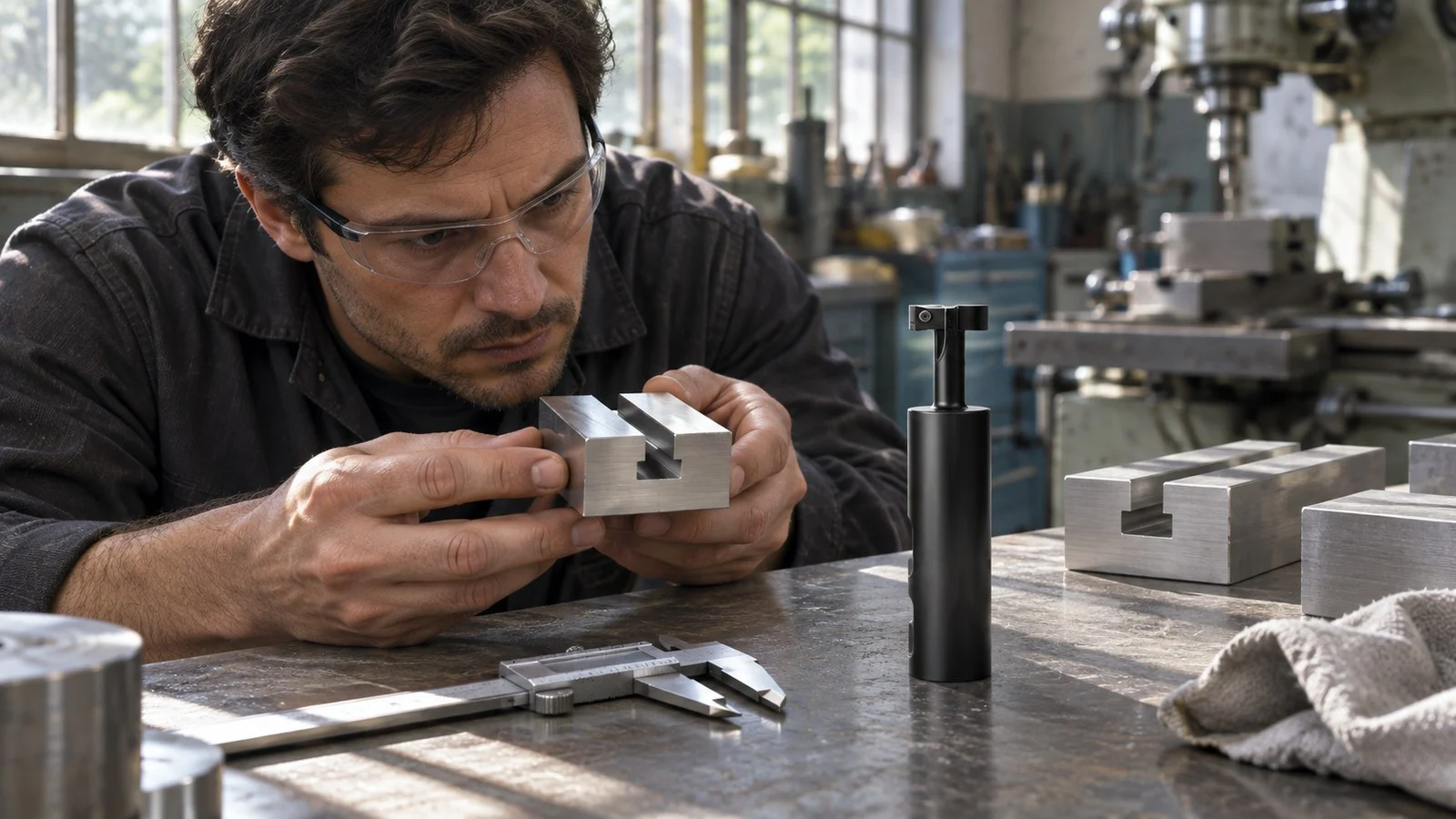
Choose a dovetail cutter for a profile with sloping sides, such as a dovetail slide. Choose a T-slot cutter for a square undercut beneath a narrower slot opening. In a dovetail cutter vs T-slot cutter decision, the drawing’s profile and the tool’s access to it determine the choice.
Dovetail Cutter vs T-Slot Cutter: Key Differences
A dovetail cutter forms an angled profile, while a T-slot cutter forms the wider section beneath a slot opening. Both choices require a check of the drawing and tool clearance. For either feature, an initial straight slot is commonly prepared with an end mill before the form cutter is used.
| Consideration | Dovetail Cutter | T-Slot Cutter |
|---|---|---|
| Required profile | Angled sides forming a dovetail | Square undercut beneath a narrower opening |
| Typical use | Dovetail slides and matching profiles | T-slots in machine tables and beds |
| Tool geometry | Cutting angle and form must match the drawing | Cutter head, neck and shank must suit the slot |
| Access | Depends on the profile, cutter form and setup | The neck and shank must pass through the opening |
| Initial slot | Often roughed with an end mill | A straight slot is commonly prepared before undercutting |
Dovetail Cutter: Pros, Cons and Uses
A dovetail cutter has angled cutting geometry for producing a dovetail profile. Its strength is matching sloping sides on features such as slides. The cutter’s angle must match the specified profile; an angle suitable for one job won’t necessarily suit another.
The drawback is that the angle alone doesn’t settle the selection. Ordinary and inverted dovetail cutters are different forms, so check which side of the profile the tool must produce. Also check whether the cutter can reach the feature in the chosen setup.
Dovetail cutters suit drawings that call for sloping sides. A straight slot may be roughed first with an end mill, but the actual sequence depends on the drawing, tool and machine.
T-Slot Cutter: Pros, Cons and Uses
A T-slot cutter forms the wider, square undercut below a narrower opening. It suits T-slots such as those used in machine tables and beds, where the required profile calls for an undercut rather than sloping dovetail sides.
The access requirement is a key limitation: the cutter’s neck and shank need clearance through the opening to reach the wider section. Check those dimensions against the drawing and the actual tool before selecting it. A straight slot is commonly prepared first, often with an end mill.
For a T-slot profile, you can review our T-Slot Milling Cutter and check its dimensions against the job requirements.
Which Cutter Should You Choose?
Choose a dovetail cutter if:
- The drawing calls for sloping sides on a dovetail profile.
- The cutter angle matches the specified angle.
- The ordinary or inverted cutter form matches the feature to be machined.
Choose a T-slot cutter if:
- The drawing calls for a square undercut beneath a narrower opening.
- The cutter head matches the required undercut.
- The opening provides clearance for the cutter’s neck and shank.
Before machining, check the intended entry path and operation sequence against the drawing, tool dimensions and machine setup.
FAQ
Can a T-Slot Cutter Cut a Dovetail?
Select the cutter by the required profile. A T-slot cutter is intended for a square undercut; a dovetail profile requires cutting geometry that matches its sloping sides.
Is an End Mill Used First?
An end mill is commonly used to prepare an initial straight slot before a form cutter. The appropriate sequence depends on the drawing, tool and machine.
Are All Dovetail Cutters the Same?
No. Dovetail cutters have different angles, and ordinary and inverted forms produce different profiles. Match both the angle and the cutter form to the drawing.