

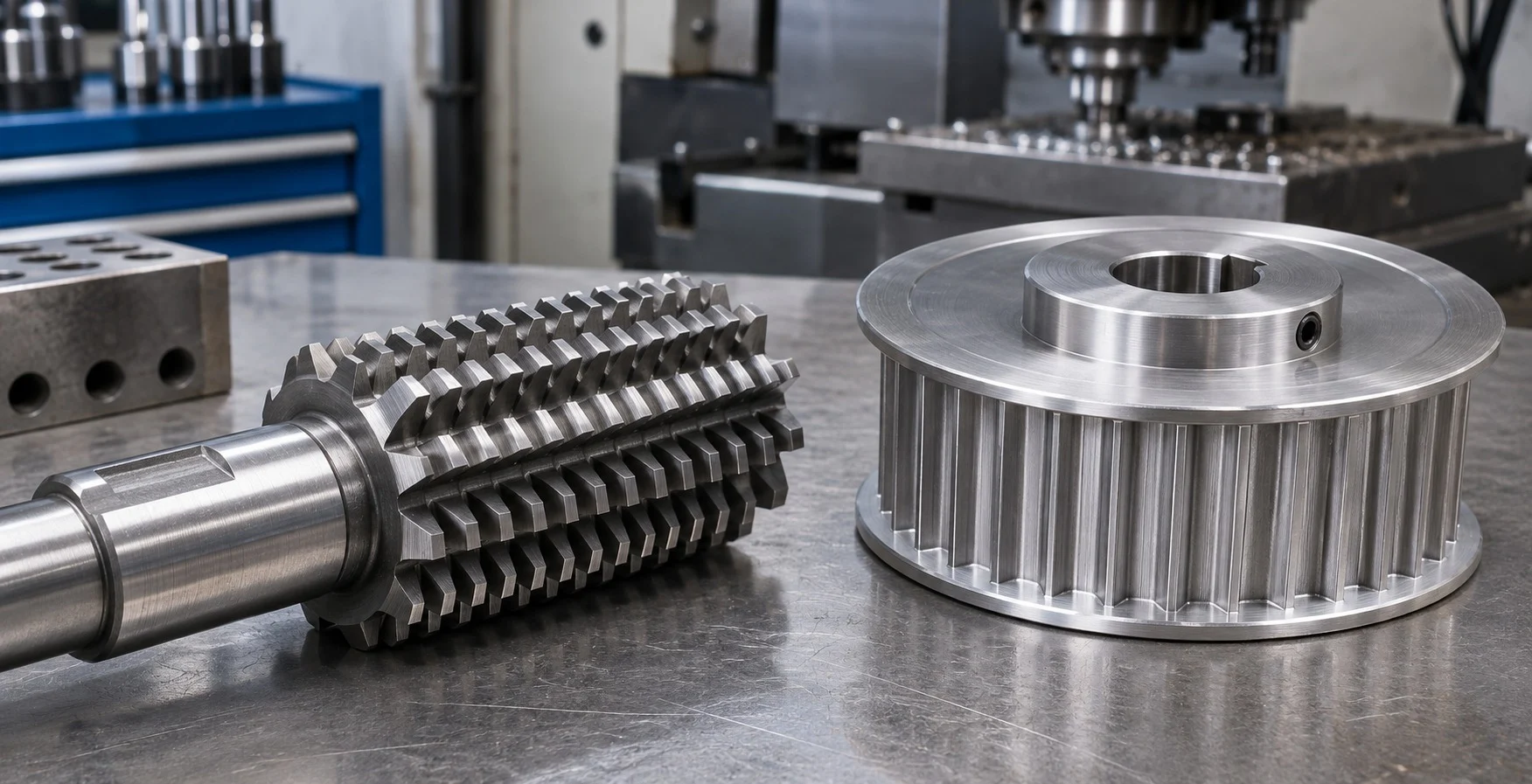
Selecting a timing pulley hob starts with the required tooth geometry, not with a tool chosen by name alone. A hob must generate the specified pulley profile on the intended machine while meeting the drawing’s requirements for fit, accuracy and surface finish. Confirm those inputs before comparing tool designs or requesting a quotation.
Start With the Pulley Drawing and Standard
Record the pulley’s tooth profile and pitch, tooth count, outside diameter, face width, and any specified tolerances. Timing-belt systems use profiles that may look similar but are not necessarily interchangeable. Do not infer the profile from the belt’s appearance or a nominal pitch alone. Use the drawing, applicable product specification and mating-belt information to establish the required geometry.
Check whether the pulley is intended for a particular belt family and application. The tooth form affects engagement, load transfer and clearance. If the drawing omits a critical profile designation or tolerance, resolve the ambiguity with the design authority before ordering a hob.
Match the Hob to the Machine and Operation
Confirm the hobbing machine’s interface, available arbor or mounting arrangement, workpiece capacity, cutting direction and operating method. The hob’s module or pitch-related geometry, pressure angle or profile data, and lead must be compatible with the pulley design and machine setup. These values depend on the specified tooth form; they should come from the drawing, standard or toolmaker’s approved design rather than guesswork.
Discuss the intended production route with the tool supplier. A hob for a dedicated production setup may differ from one chosen for flexible, low-volume work. Ask the supplier to confirm the tool design against the drawing and machine details, including any required generating relationship, clearance, and setup constraints. Wencerl’s metal cutting tool range is a useful starting point for discussing a tool matched to a specific application.
Consider Workpiece Material and Production Conditions
Identify the workpiece material and condition, such as whether it is supplied as a casting, bar stock or a pretreated blank. Material, hardness, stock allowance and machine rigidity all influence tool material, edge preparation and the recommended cutting conditions. Do not assume that a parameter set for one alloy or blank condition transfers to another.
Share the expected batch size, available coolant or lubrication arrangement, machine condition and target quality with the toolmaker. These factors affect tool-life planning and the balance between cycle time and process stability. Use only tool-specific cutting data supplied or approved by the manufacturer. If conditions change, validate the revised setup before relying on previous process results.
Plan Setup, Inspection and Tool Life
Before cutting, verify the blank dimensions, datum references, workholding, hob alignment and machine settings against the setup documentation. Keep guards and interlocks in place, and follow the machine and tool manufacturers’ instructions for installation, rotation, coolant and safe operation. Stop and investigate unusual vibration, noise, chip behavior or surface defects instead of compensating with unapproved parameter changes.
Define how the finished pulley will be checked. Depending on the drawing, inspection may include tooth profile, pitch-related dimensions, runout, bore, face width and surface condition. Choose suitable gauges or measurement methods for the specified tolerances, and record results during initial setup. A trial cut can reveal whether the process produces the intended geometry before production quantities are committed.
Track tool usage and quality trends. A consistent inspection plan helps distinguish normal wear from setup errors, blank variation or a developing machine issue. Follow the supplier’s guidance for regrinding, recoating or replacement; an altered tool must be rechecked for its suitability and setup.
FAQ
Can one timing pulley hob cut every pulley profile?
No. The hob must match the specified tooth geometry and the machine setup. Similar-looking profiles should not be treated as interchangeable.
What information should I provide when requesting a hob?
Provide the drawing or complete profile designation, workpiece material and condition, machine and mounting details, production needs, and applicable quality requirements.
Should I choose cutting parameters from a general chart?
Use tool-specific recommendations for the actual material, machine and setup. Follow the manufacturer’s instructions and validate the process safely.