

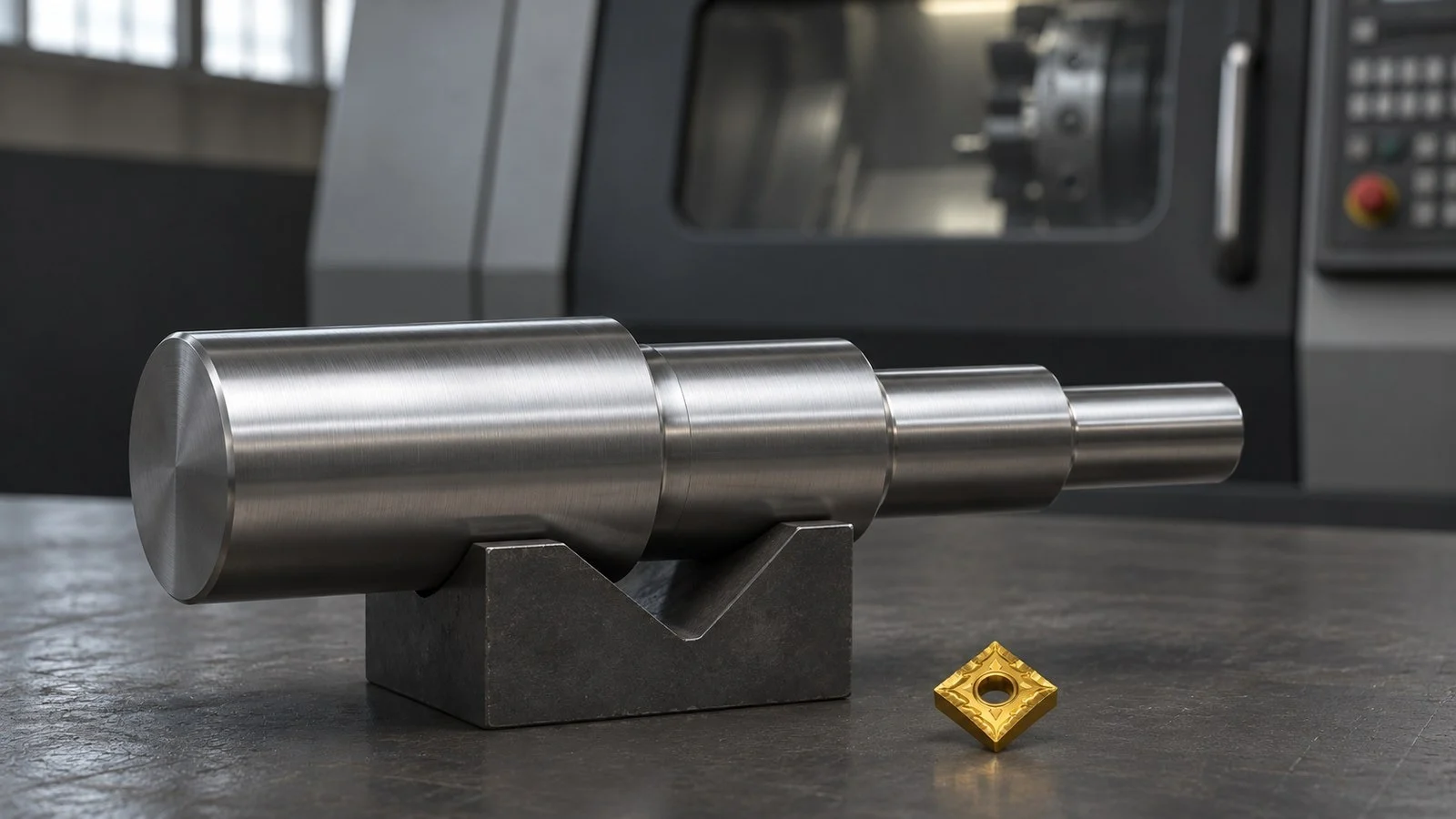
For CNC lathe programmers, constant surface speed (CSS) suits facing and cuts across changing diameters; constant RPM suits cuts at a relatively steady diameter. CSS adjusts spindle speed as cutting diameter changes, while constant RPM uses rotation speed as the spindle control mode.
Constant Surface Speed vs Constant RPM: Key Differences
CSS adjusts spindle RPM as the cutting diameter changes to maintain the programmed surface speed, within the controller’s limits. Constant RPM uses a rotation-speed mode, so surface speed changes as diameter changes. Choose based on whether the cut crosses a wide range of diameters or stays relatively steady.
| Turning mode | What the mode targets | What changes | Often suits |
|---|---|---|---|
| Constant surface speed | Cutting surface speed, within the controller’s limits | Spindle RPM as diameter changes | Facing and turning across a wide diameter range |
| Constant RPM | Spindle rotation speed | Cutting surface speed as diameter changes | OD cuts at a relatively constant diameter |
The terms describe spindle mode, not feed mode. Feed per revolution and feed per minute are separate settings, and a controller’s compatibility rules can affect which combinations are valid.
Constant Surface Speed: Pros, Cons and Best Uses
CSS adjusts spindle RPM as the cutting diameter changes, aiming to maintain the programmed surface speed. In diameter-based CSS, RPM rises as the tool approaches the center and falls as it moves outward. On MASSO controllers, G96 uses the S word for target surface speed and D for the spindle RPM limit. MASSO G96 documentation
That changing speed makes CSS useful for facing and turning profiles with substantial diameter changes. For example, at 100 m/min, the ideal spindle speed is about 318 RPM at a 100 mm diameter and 637 RPM at 50 mm. The surface-speed target stays the same while RPM changes.
The tradeoff is that RPM demand can rise sharply near the center. Before using CSS, verify the maximum RPM allowed by your machine and workholding instructions, then use the controller’s documented cap within that limit. Don’t assume a cap value or code syntax transfers between controllers.
Feed mode needs its own check. On MASSO controllers, CSS does not work with G95 feed per revolution, and using G96 and G95 together can give unexpected results. Check your controller’s documentation for compatible combinations.
Constant RPM: Pros, Cons and Best Uses
Constant RPM uses rotation speed as the spindle control mode. LinuxCNC uses G97 for rotation-speed control and G96 for constant-surface-speed control. LinuxCNC G-code documentation
This mode is a straightforward choice for an OD cut where the working diameter stays relatively constant. Its tradeoff is that cutting surface speed varies with diameter: at the same RPM, a larger diameter has a higher surface speed than a smaller one.
For facing or a profile with a broad diameter range, fixed RPM may be less suitable if your goal is to keep surface speed consistent. The appropriate choice still depends on your machine, workholding, tooling, and controller’s documented behavior.
Which Turning Mode Should You Choose?
Choose CSS when:
- You’re facing across a changing diameter and want the surface-speed target to remain steady.
- Your controller supports CSS for the feed mode you plan to use.
- You’ve checked the machine and workholding RPM limit and set the controller’s documented cap.
Choose constant RPM when:
- The cut stays at a relatively constant diameter.
- You want the spindle to use one programmed rotation speed.
- Your controller setup or operating requirements call for fixed spindle RPM.
When selecting an insert for a turning operation, treat mode choice and insert choice as separate decisions. The CNMG120404-CQ WLN18 turning insert is one catalog example.
FAQ
Does CSS Keep RPM Constant?
No. CSS aims to keep cutting surface speed steady by changing spindle RPM as the cutting diameter changes, subject to the controller’s RPM limit.
Does Constant RPM Keep Surface Speed Constant?
No. Constant RPM uses a steady spindle rotation speed, while cutting surface speed changes with diameter.
Is CSS the Same as Feed Per Revolution?
No. CSS controls spindle speed in relation to cutting diameter. Feed per revolution controls tool feed relative to spindle rotation, and compatible combinations depend on the controller.