

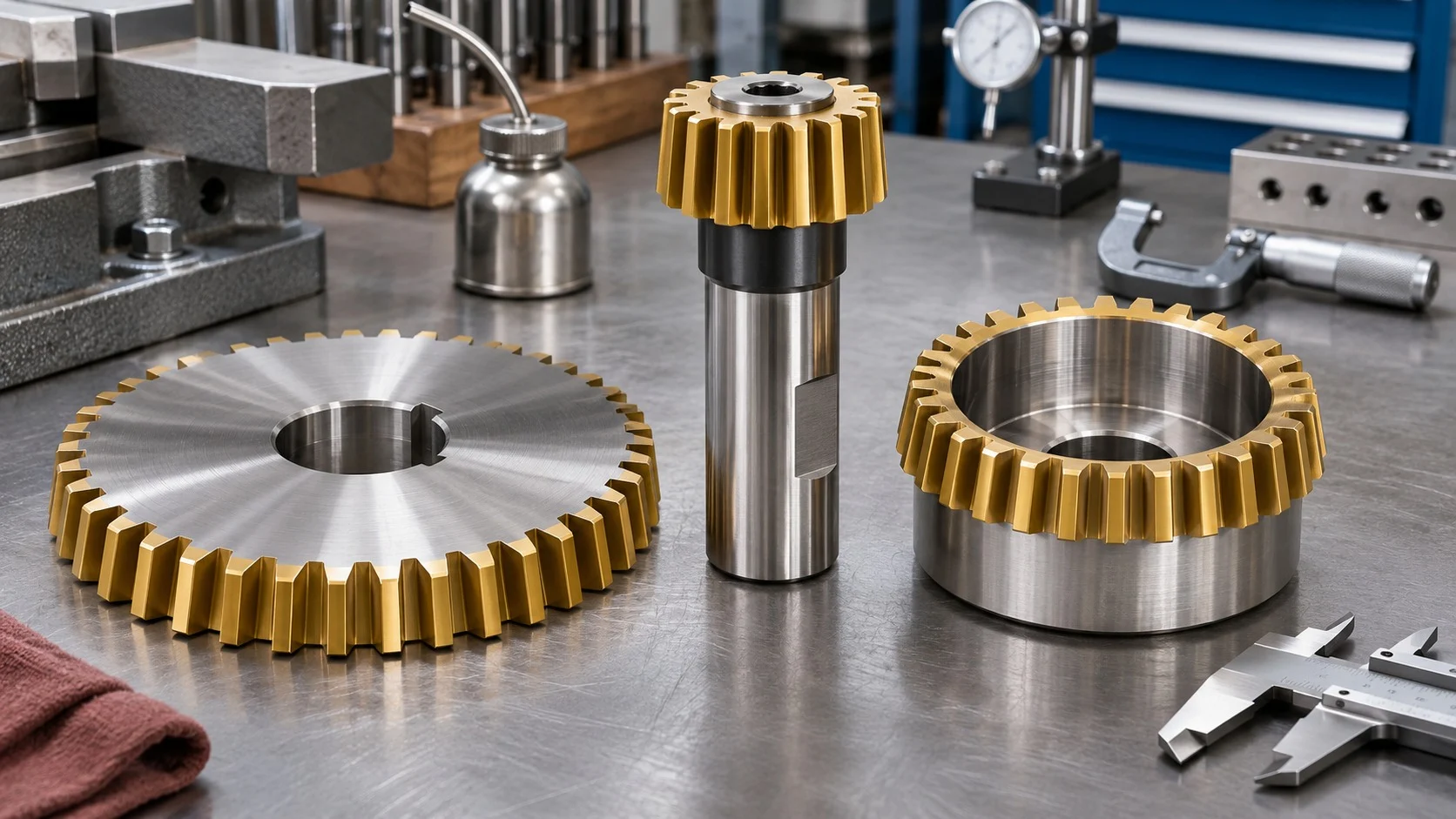
Choosing among disc, shank and cup cutters is mainly a question of machine compatibility, workpiece access and the gear geometry to be generated. The cutter must match the required tooth system and operate within the shaper’s approved setup. A familiar shape or convenient mounting style is not enough to establish suitability.
What the Three Forms Have in Common
A gear shaper cutter is a cutting tool used in a generating process: the cutter and workpiece move in a coordinated relationship to produce gear teeth. Cutter geometry, tooth data, material and sharpening condition all matter. The cutter must be designed for the specified gear, machine and operation, including any required clearance to adjacent features.
Before comparing body styles, confirm the gear drawing and the machine documentation. Establish the tooth system and required geometry, workpiece material, face width, nearby shoulders or other obstructions, mounting interface and available stroke. Ask the toolmaker to verify the cutter design and setup against these inputs.
Disc Cutters
A disc-style cutter has a wheel-like body and is commonly considered for external gear work when the machine’s mounting arrangement and the part geometry provide suitable access. Its form can be practical for general setups, but actual suitability depends on the cutter dimensions, machine clearance and the location of shoulders or other features near the teeth.
Check the cutter body and mounting arrangement against the machine and workpiece envelope. Confirm that the cutter can reach the intended tooth width without collision and that the specified cutting and relief geometry is correct. Do not assume that a disc cutter can reach a gear located close to a face or obstruction simply because its diameter appears adequate.
Shank Cutters
A shank cutter uses an integral or attached shank for mounting, which may help where the machine or part requires a narrower approach. This can be relevant for internal gears or restricted access, depending on the machine, cutter design and surrounding geometry. The shank also introduces its own clearance and rigidity considerations.
Check shank diameter, reach, mounting details and the available clearance through the workpiece opening. The setup must avoid interference while maintaining the support and alignment required by the machine. A long or slender arrangement should be assessed with the toolmaker for the intended cut; do not infer safe operating limits from appearance alone.
Cup Cutters
A cup-style cutter has a hollow body form that may be useful for particular machine arrangements and workpiece clearances. Whether it is suitable depends on the gear location, surrounding features and the cutter’s designed cutting geometry. The body shape can create access in one direction while imposing limits in another.
Review the full cutter envelope, not just the cutting edge. Confirm clearance to the workpiece, fixture and machine throughout the stroke and generating motion. The toolmaker should verify that the selected cup form is intended for the specific gear and operation.
Make the Selection From the Setup Outward
A practical selection sequence is to confirm the gear specification, identify the machine and mounting interface, map the workpiece and fixture envelope, then compare cutter forms for access and rigidity. Include material, production quantity, sharpening plan and inspection method in the discussion with the supplier. Wencerl’s metal cutting tools can be considered as part of a tool-selection conversation based on these application details.
Follow the machine and cutter manufacturers’ instructions for installation, alignment, cutting parameters, lubrication and guarding. Check tool condition before use, secure the workpiece and fixture, and verify clearances with the approved setup procedure. Any trial cut should be inspected against the drawing before production proceeds.
FAQ
Is a cup cutter always for internal gears?
No. Cutter form alone does not define the application. Confirm the cutter design, machine setup and gear geometry with the toolmaker.
Which cutter type offers the best access?
It depends on the machine, workpiece features, mounting and full tool envelope. Compare those details before choosing a body style.
Can I substitute a different cutter form with the same tooth data?
Only if the replacement is approved for the machine, operation and clearance conditions. Matching tooth data alone does not confirm setup suitability.