

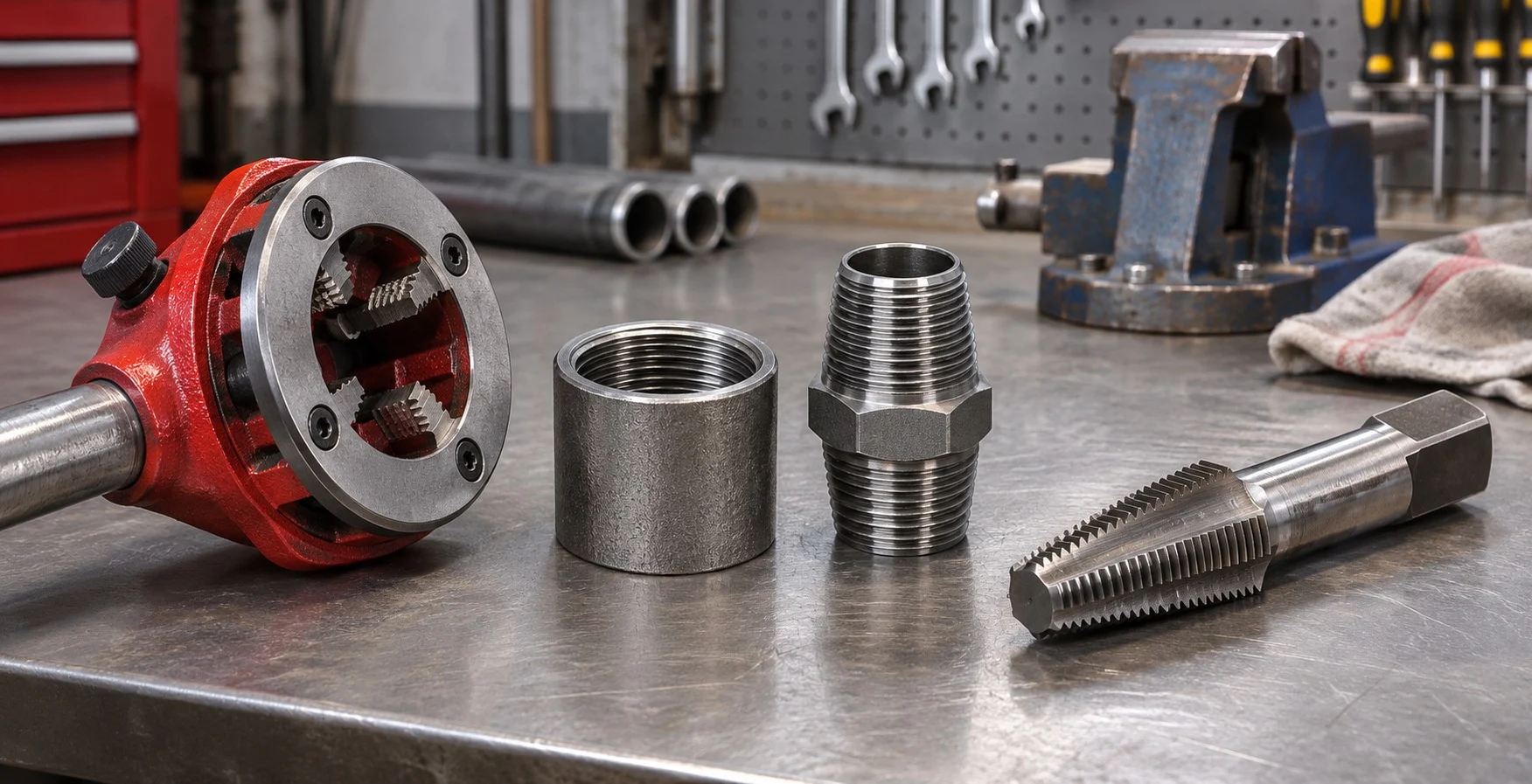
NPT and BSPT are tapered pipe-thread systems used in different specification contexts. Their names are not sufficient for selecting a thread mill: the exact designation, size, pitch, thread form and applicable governing standard must be confirmed. Do not treat the systems as universally interchangeable or assume a tool intended for one will produce an acceptable thread in the other.
Verify the Full Thread Designation
Begin with the part drawing or engineering specification. Record the complete thread callout, including the system, nominal size and any relevant class or tolerance information. Confirm which governing standard the design references and whether the thread is internal or external. If the callout is incomplete or conflicting, resolve it with the design authority before machining.
NPT and BSPT can differ in thread form and pitch for a given nominal size, and their application requirements are controlled by their respective standards. Verify the included thread angle, pitch and taper from the applicable standard or authoritative drawing. Do not rely on a generic conversion chart or a visual comparison of fittings to define acceptance criteria.
Match the Thread Mill to the Required Geometry
Once the thread specification is confirmed, ask the toolmaker to verify that the thread mill is designed for that thread form and size range. Check the tool’s cutting geometry, diameter, reach, flute configuration and intended material range against the part and machine. Tool availability and design vary, so do not infer capability from the product name alone.
The programming method must also account for the required taper and thread geometry. Confirm the programmed path, entry method, interpolation capability and any tool compensation approach against the machine control and toolmaker guidance. A path for a straight thread does not automatically create the required tapered thread. Validate the setup with the approved process and suitable inspection method.
Control Material, Access and Setup
Provide the workpiece material, hardness or condition, thread depth, available access and coolant arrangement when selecting the tool and cutting data. These factors influence tool choice and process stability. Use manufacturer-recommended parameters for the specific tool, material and machine; avoid transferring values from a different thread system or workpiece without approval.
Before machining, secure the part and verify the work offset, tool length, programmed taper and clearance. Follow machine guarding and tool installation instructions. Confirm that chips can clear the thread, especially in a blind hole, and use the recommended coolant or chip-control method. Stop if the tool chatters, chips pack, or inspection indicates a geometry problem; do not compensate by changing the thread path without determining the cause.
Inspect to the Governing Requirement
Use the inspection method specified by the drawing or governing standard. Depending on the requirement, this may involve appropriate thread gauges and dimensional checks. Confirm that the gauge itself corresponds to the stated thread system and size. A fitting that appears to engage is not proof that the thread meets its specification, seals as intended or is interchangeable with another system.
Keep the thread callout, tool identification, program revision and inspection results together in the process record. If a part fails inspection, verify the designation and setup first, then review tool condition, compensation, machine motion and material. Wencerl’s metal cutting tools can be a starting point for discussing a thread mill selection with the complete drawing and application details.
FAQ
Are NPT and BSPT interchangeable?
Do not assume interchangeability. Confirm the exact thread designations, mating components and applicable engineering requirements.
What should I compare before choosing a thread mill?
Verify the specified thread system, size, pitch, angle, taper, workpiece material, access and machine capability against the toolmaker’s recommendations.
Can a standard straight-thread toolpath cut a tapered pipe thread?
Not by assumption. The path must generate the specified taper and thread geometry, and the result must be inspected to the governing requirement.