

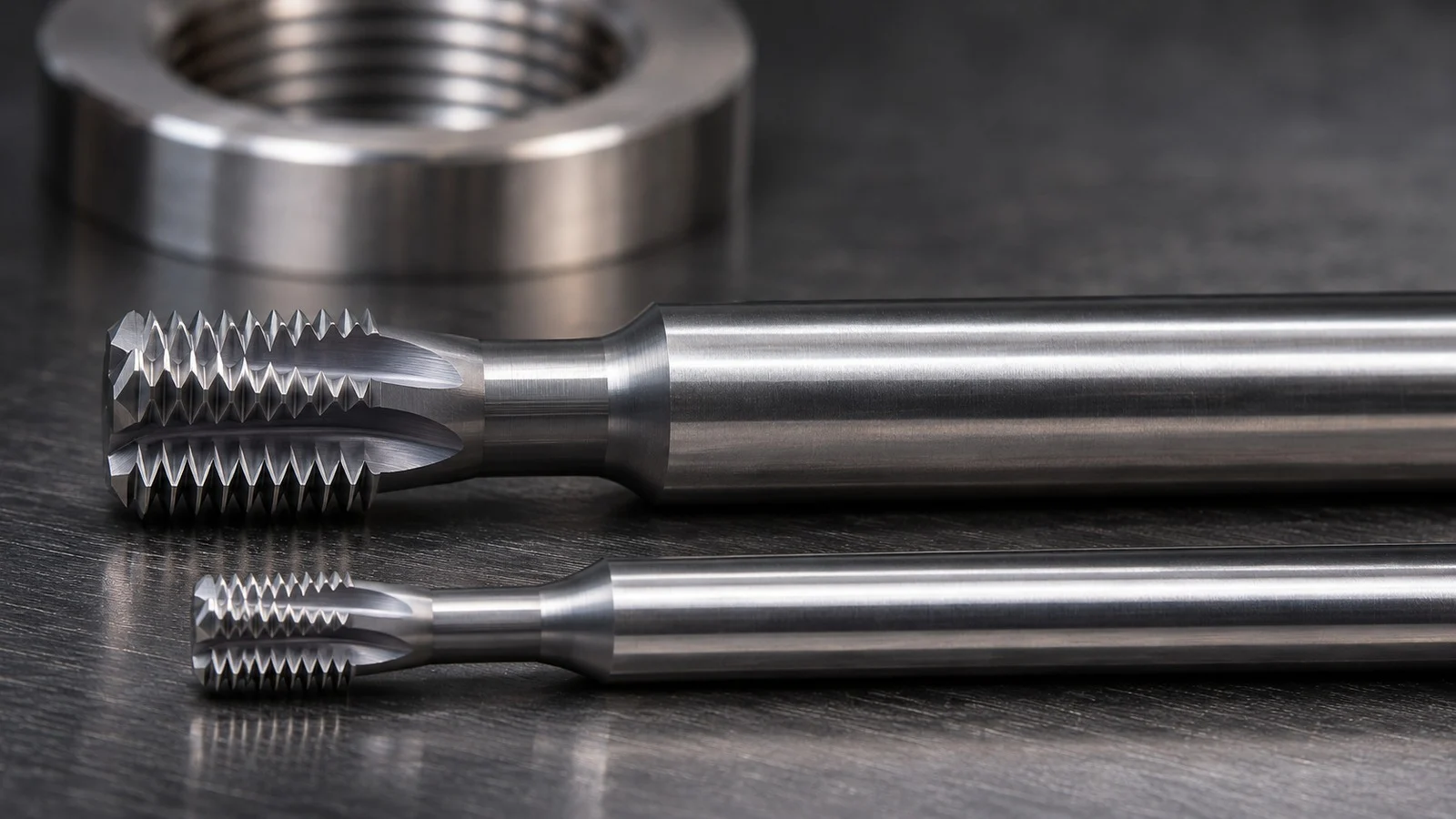
Thread milling cutter diameter selection starts with physical fit and the toolmaker’s limits for the specific thread. A smaller cutter can reduce profile deviation, while a larger one can improve stiffness and process stability. The right choice balances those needs among cutters approved for the thread’s pitch, profile, and reach.
Thread Mill Diameter Selection
Choose the largest chart-approved cutter that meets the thread’s profile-accuracy needs and clears the setup. A smaller diameter can reduce profile deviation; a larger diameter can improve bending stiffness and process stability, especially with greater overhang. Check physical clearance separately, then confirm the cutter against the toolmaker’s limits for the thread.
- Fit: Check the pre-machined bore for internal threads and the setup clearance for external threads.
- Pitch and profile: Match the toolmaker’s chart to the thread form and pitch.
- Depth and reach: Confirm the cutter can reach the full thread within the chart’s limits.
Internal Thread Cutter Diameter
For an internal thread, the pre-machined bore determines whether the cutter can physically enter and move through the hole. That bore is distinct from the reference thread diameter used in a toolmaker’s ratio guidance. Check both: a ratio screen doesn’t replace the bore-clearance check or the toolmaker’s chart.
Sandvik’s internal profile-deviation guideline says the cutter diameter should be no greater than 70% of its stated threading diameter to minimize deviation (Sandvik Thread Milling Guide, PDF). ISCAR recommends an initial endmill diameter up to 70% of the thread major diameter in most internal applications (ISCAR Threading Handbook, PDF). These are toolmaker examples with different diameter references; follow the chart for the selected cutter and thread.
As an arithmetic screen using ISCAR’s internal major-diameter reference, a 20 mm thread major diameter gives 14 mm at 70%. That 14 mm is neither the pre-machined bore diameter nor proof that a 14 mm cutter is suitable. The cutter still has to clear the bore and meet the applicable chart limits for pitch, profile, and reach.
External Thread Cutter Diameter
For external threads, the initial cutter diameter can be over 70% of the thread major diameter in most cases under ISCAR’s guidance (ISCAR Threading Handbook, PDF). Bore fit doesn’t apply, but the cutter, holder, and swept path must clear the fixture and any shoulder. Check the chart for the applicable pitch, profile, and reach.
For a deep-hole setup, Wencerl lists a Deep Hole Thread Milling Cutter Holder. Check its product details against your machine and tool requirements before selecting it.
FAQ
Is 70% a Universal Limit?
No. These percentages are toolmaker-specific guidance: Sandvik’s internal guideline uses its stated threading diameter, while ISCAR’s internal starting guidance uses thread major diameter and applies in most cases.
Does the Internal Bore Set the Ratio?
No. Use the pre-machined bore to check physical clearance and the toolmaker’s stated thread diameter for its ratio guidance.
Can an External Cutter Exceed 70%?
Yes, in most external cases under ISCAR’s guidance, if the chart and setup clearances allow it.