

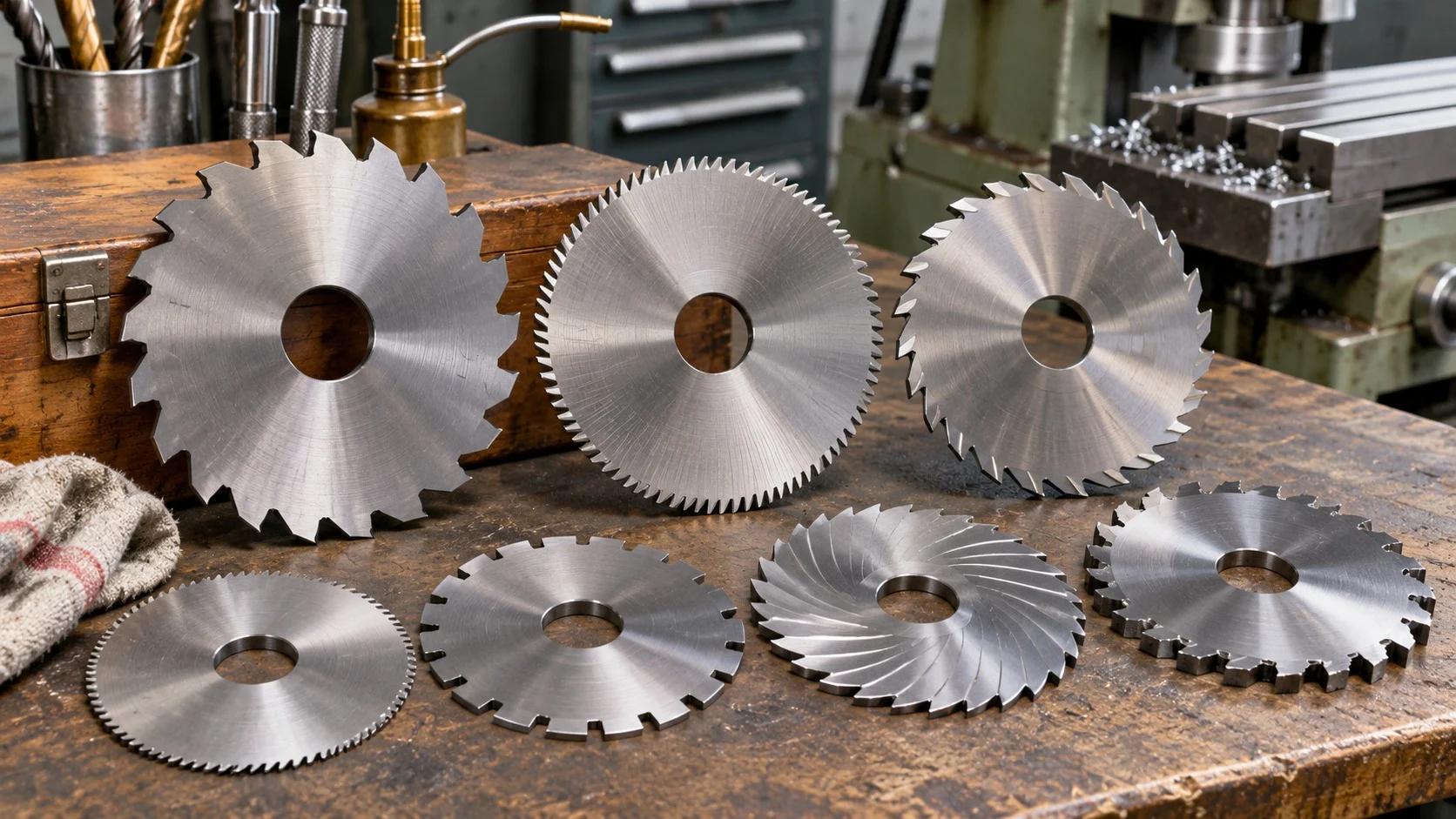
A slitting saw’s tooth count and pitch affect tooth engagement, chip space, and load distribution. Choose them together with saw diameter, workpiece material, slot dimensions, and machine setup. The aim is to clear chips while keeping engagement and feed per tooth appropriate for the tool and operation.
What Tooth Count and Pitch Mean
Tooth count is the number of cutting teeth around the saw. Pitch describes the spacing between adjacent teeth. At the same diameter, more teeth mean finer pitch and fewer teeth mean coarser pitch.
Finer pitch places more teeth along a given contact arc. Coarser pitch provides more space between teeth, but chip capacity also depends on gullet shape and depth. Inspect the gullets when comparing tooth counts. Coarse- and fine-pitch designs are illustrated in the RobbJack saw application guide.
Match the Pitch to Material and Cut Conditions
Start with how the material forms chips. Bulky or long chips need space to form and leave the cut. Fine pitch can be unsuitable if chips pack into the gullets. Material compatibility, tooth form, and toolmaker guidance should determine the final choice.
Check slot depth and width against the saw and mounting arrangement. Deep or narrow slots can restrict chip evacuation. Confirm that the arbor and flanges clear the workpiece and fixture at full depth, including entry and exit. Check the saw’s specified side clearance throughout the path.
Keep the setup rigid. Clean the arbor and mounting faces, confirm alignment, and secure the workpiece. Runout can concentrate the cutting load on individual teeth and affect slot width or finish.
Use Tooth Engagement as a Check
Check the arc of the saw’s circumference actually in contact with the workpiece. For evenly spaced teeth, approximate engaged teeth = tooth count × engagement arc in degrees ÷ 360.
A longer engagement arc brings more teeth into contact at the same tooth count. Increasing tooth count also increases engagement over the same arc. Estimate the contact arc from saw diameter, radial cutting depth, and workpiece geometry, allowing for changing engagement during entry and exit.
Use this geometric estimate alongside gullet capacity and the toolmaker’s application guidance. Too few teeth in contact can make cutting intermittent. A suitable engagement range depends on the actual saw and operation.
Also check feed per tooth whenever tooth count changes. The RobbJack guide gives table feed = RPM × chip load per tooth × tooth count. Rearranging this relationship gives the following calculation.
Feed per tooth = table feed ÷ (RPM × tooth count).
At fixed RPM and table feed, increasing tooth count reduces feed per tooth. Decreasing tooth count increases it. Recheck the toolmaker’s recommended chip load before running the replacement saw.
Set Up and Prove the Cut Safely
Before machining, inspect the saw for damage, verify tool suitability, and install it according to the machine and tool instructions. Confirm work offsets, mounting clearance, and the complete toolpath before cutting.
Use tool-specific speed, feed, and coolant or lubrication guidance. Avoid side loading unless the saw is designed for it. Stop for abnormal vibration, noise, chip packing, or changing cutting load. Clear chips only after the spindle has stopped.
Inspect slot width, burrs, and surface condition. If the saw binds or the slot is inconsistent, investigate alignment, runout, workholding, chip evacuation, and tool condition before adjusting cutting values.
For broader tool selection, read our slitting saw vs. end mill guide on Wencerl.
FAQ
Should a Slitting Saw Have More Teeth for a Smoother Cut?
More teeth can distribute engagement, but closer spacing also reduces the space between teeth. Smoothness depends on the full tool and setup, including gullet geometry, rigidity, runout, material, and cutting conditions.
Is a Coarse Pitch Always Better for Aluminum?
A coarse pitch may provide more chip room, but suitability depends on the specific alloy, saw geometry, slot, and manufacturer guidance. Check chip evacuation and the recommended cutting data for the actual application.
What Information Helps a Supplier Recommend a Saw?
Provide the material, slot width and depth, saw diameter and thickness constraints, machine and arbor details, workholding, tolerance, and current cutting conditions if available.